Appendix N
best early Xmas present ever

Quick plug: I’m giving a short talk on “My Stem Cell Summer” to my Rotary club, Crescent, today at noon at The Terrace inside the Greensboro Coliseum Complex. I’ll write up a longer version here over Xmas break.
A Bookish Barista
Julie Wade has been setting up her sidewalk table outside Tate Street Coffee since before I started at UNCG in 2022. How long, I’m not sure. Internet research confirms rumors that she had a bookmobile at one point. But now she has a windowed nook on Spring Garden near Mendenhall, next door to a bike shop and close by the venerable comic shop Parts Unknown.
I was there for the grand opening the Sunday before Thanksgiving and found a beat-up copy of The Big Book of Science Fiction, which I mentioned in the context of Jeff Vandermeer coming to town last spring.

Congratulations to Ms. Wade. I wish her the absolute best with the business.
Uncanny Xmas
I’ve been a fan of Peter Bebergal for years. I don’t think I read more than an excerpt of his memoir, Too Much to Dream, I assume inspired by an Electric Prunes song that was later covered by my favorite rock & roll action figure, Webb Wilder.
I know that I never read Season of the Witch, Bebergal’s history of occult influences on popular music. But Strange Frequencies: The Extraordinary Story of the Technological Quest for the Supernatural? Cover to cover. I was less interested in his attempts to construct a golem (excerpted in the sample on Penguin’s website) than in his explorations of how every single new technology, from photography to radio and television to digital audio recordings, is immediately put to use in trying to reach the Other Side. From an interview he did with WBUR in Boston when the paperback came out:
“If you’re dead, you don’t have a body — you’re just a disembodied consciousness, you don’t have vocal cords,” Bebergal said, explaining their rationale. “So you need something like radio waves to be able to align your dead consciousness with in order for people on the other side to be able to hear you.”
As an aside, the documentary Smile for the Dead tries to recreate Mumler’s spirit photographs. I saw that on Tubi a few weeks ago. The director, Hamilton Young Ward, was also involved in a project about how bots are like magicians’ familiar spirits. Pretty cool, for multiple reasons, not least of which is how they spotlight their student interns on the website. Another is how it ties in with today’s short story, below the paywall.
But On to the Present
There’s a good podcast interview with Bebergal about his editorial process and decisions embedded into this piece.
Appendix N was Gary Gygax’s list of inspirations for D&D, which was pulpy and infused with necromantic horror vibes — more weird fiction than swashbuckling or straight-up adventure stories. There have been other lists in later editions.
while Appendix N is a window into Gygax’s pulp-infested consciousness, the “Inspirational Source Material” in the Moldvay arises out of a player’s sensibility.
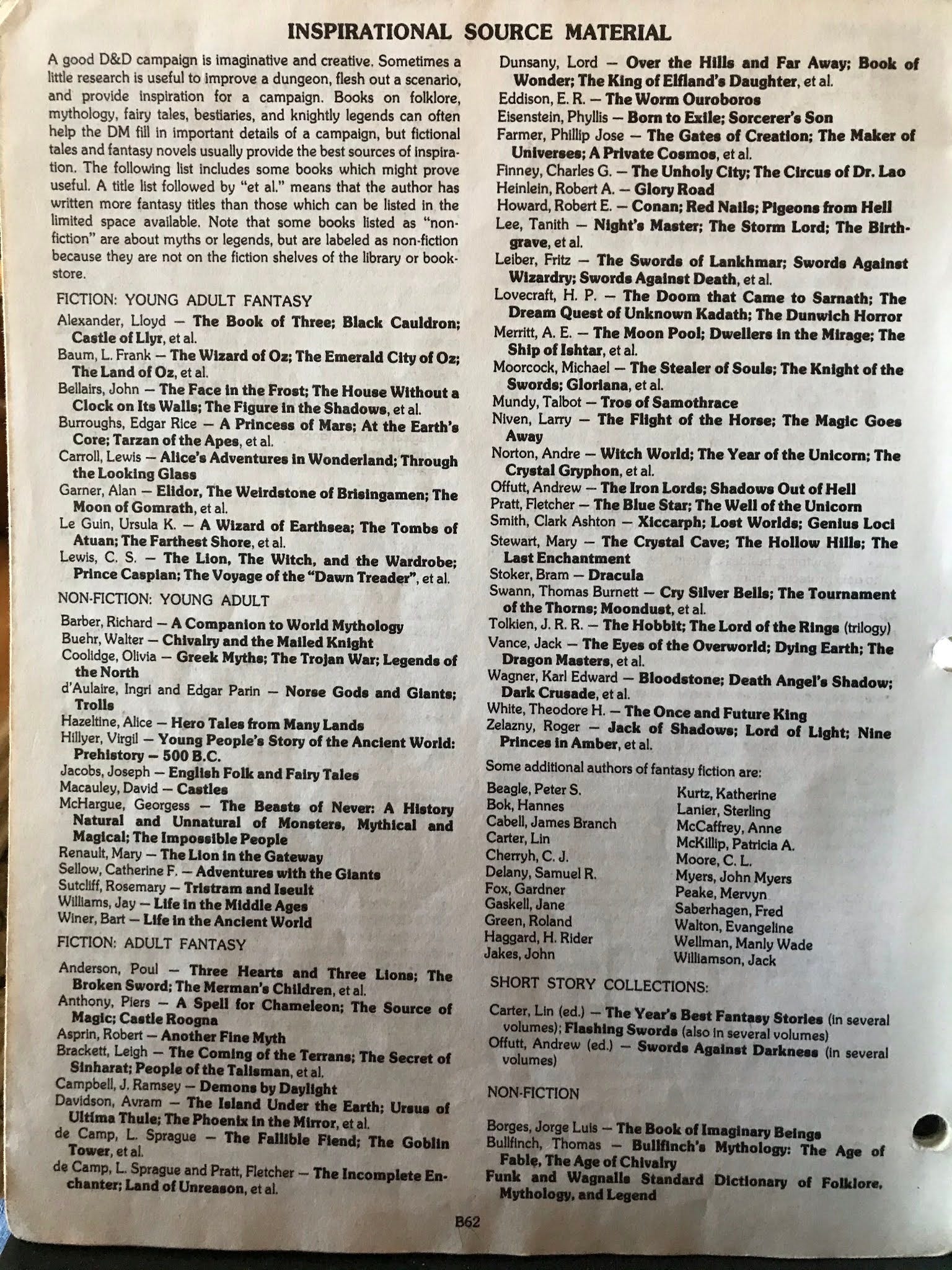
This being a short story anthology and not a bookshelf full of novels, Bebergal had to make some compromises for length, for licensing availability (he couldn’t get any Fletcher Pratt, for instance), and in some cases for his own tastes. Which is fair. It’s his book. He’s the one who spent so much time trolling through the Internet Speculative Fiction Database, tracking down examples of the specific flavor of ‘eldritch’ that he was after.
The one author that I personally felt was “criminally missing from Gygax’s original” and from Bebergal’s version was Larry Niven, whose Warlock series was later listed in the Moldvay above. From “Not Long Before the End,” quoted in a review in Black Gate:
A swordsman battled a sorcerer once upon a time. In that age such battles were frequent. A natural antipathy exists between swordsmen and sorcerers, as between cats and small birds, or between rats and men. Usually the swordsman lost, and humanity’s average intelligence rose some trifling fraction. Sometimes the swordsman won, and again the species was improved; for a sorcerer who cannot kill one miserable swordsman is a poor excuse for a sorcerer.
As much as I liked the prose version of The Magic Goes Away, with the b&w illustrations by Esteban Maroto, I might like the graphic novel by Paul Kupperberg and Jan Duursema even more.
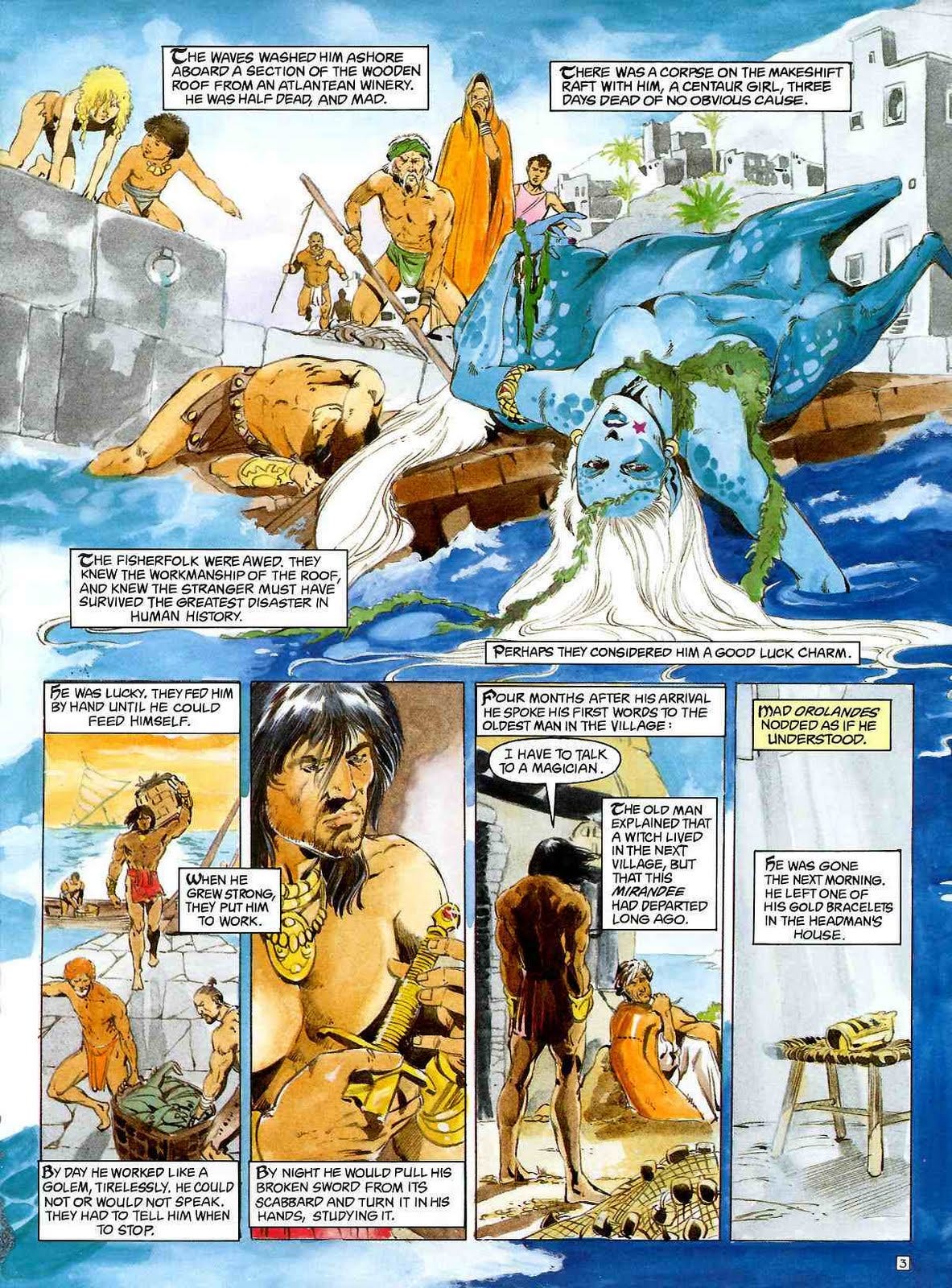
Orolandes the Greek, part of the invasion force that killed the magicians who were keeping Atlantis afloat, is a swordsman. In other words, a jock, like Conan, like so many dumb-ass strongmen in media who solve problems with their fists and stupid narrative luck. I hate jocks, as characters. I want to read about smart people who solve problems. People like Niven’s Warlock.1
Of course there’s a Conan story in the book. How could there not be? “Tower of the Elephant” is so ubiquitous that modern authors nerd-check it as a cocktail in their fantasy taverns.
“A Black Lamps of Her Eyes for me,” said Sophara. “A Tower of the Elephant for the gorgeous artificer. And for you, Your Grace, a Peril on the Sea and a Rise and Fall of Empires.”
— A Year and a Day in Old Theradane by Scott Lynch
There’s also a couple of short comics in the back, “Crom the Barbarian,” by Gardner Fox and John Giunta, and “Sword of Dragonus,” by Frank Brunner. Gygax mentioned comics broadly but didn’t name any examples. Neither did Moldvay. Fair enough; most fantasy comics I’ve seen from that time were adaptations like the one above.
I’ve always loved Poul Anderson23, and the second story in the book, “The Tale of Hauk,” is a folk-flavored Viking story of inter-generational conflict that resonated with me personally. It’s not quite D&D, in one sense, because very few GMs are willing to put players in a place where their swords are useless. But an author can (and should!). A good author can even make me root for the jock, as long as there are no wizards for me to identify with.
The most (un)pleasant surprise so far, however, has been a reunion with “The Man Who Sold Rope to the Gnoles,” by Margaret St. Clair, originally published in 1951 in The Magazine of Fantasy and Science Fiction. I first read it (I think) in some Alfred Hitchcock anthology4 when I was probably ten or eleven. My mom used to leave us in the car with our older brother and our library books while she took a tiny bit of time to herself doing the grocery shopping. It is a short and nasty piece of work.
The senior gnole is a little like a Jerusalem artichoke made of India rubber, and he has small red eyes which are faceted in the same way that gemstones are . . . he had no ears. Nor was there anything on his head which could take their place in the conduction of sound . . . Nonetheless, he followed the gnole unhesitatingly when the creature motioned him within. Adaptability, he told himself, adaptability must be his watchword.
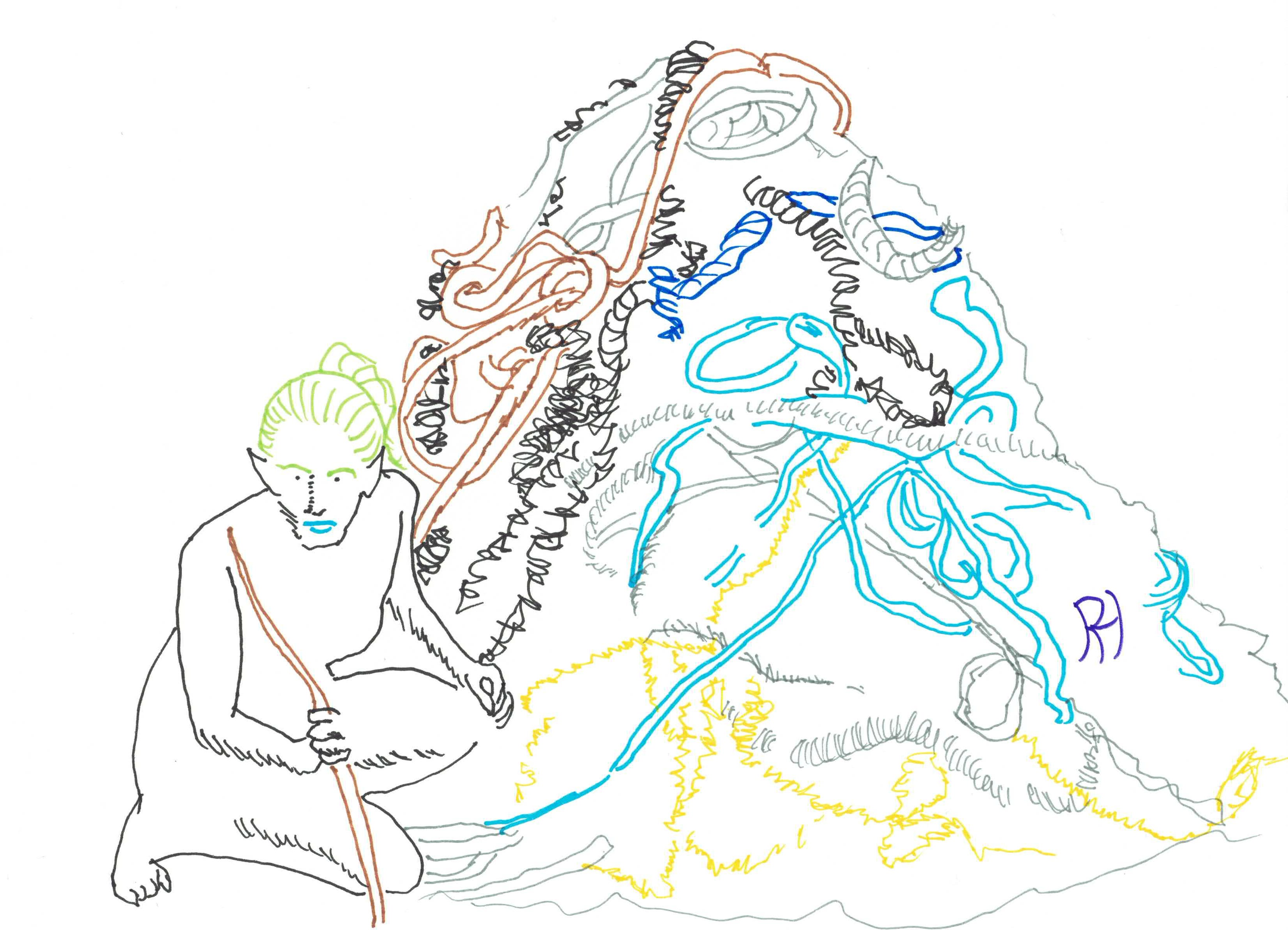
Ah, nostalgia. Two other stories I remember from around that time involved a dripping blob-like thing dredged up from the lightless depths of the abyssal plain (D&D has whole categories of slimes, jellies, and oozes) and the disastrous results of experimentally repairing the anatomical defect in an alligator’s three-chambered heart. I was a creature nerd even then.
And into the Future?
In the podcast they tease a potential sequel, an Appendix N^2, where they might get more into fanzines and comics.
The gamey-est thing I have published here on Substack, aside from last week’s Deify playtest, was my short solo campaign with Cap Doffer, the Goblin Gourmet. There’s still time to read that series if you like before it starts falling behind the paywall in a couple of weeks.

A close second (third?) in gamey-ness would be “The Hound and the Nightingale,” which appeared almost a year and a half ago in Take Me There: a Speculative Anthology of Travel, published by Winston Malone of the Lunar Awards here on Substack. Today, in the spirit of Appendix N, I am doing a personal reprint of that story, the rights to which are back in my hands.
I do like buddy stories, like the Fafhrd & Grey Mouser series, the very first of which, “The Jewels in the Forest,” from 1939, appears in Bebergal’s collection. According to Wikipedia, author Fritz Lieber wanted to write heroes who were more human than Conan or Edgar Rice Burroughs’s paragons of superhuman virtue.
Enjoy.
