Solacer
one who solaces

Today at noon I’m finally giving that stem cell talk to my Rotary club.
It’s fine if you can’t make it, because over the next week or three I’ll break the experience down in some detail here.
Today, though, I want to reflect some more on that nadir of the solar year, the solstice.
From Etymology Online:
sol(n.): the sun personified, late 14c. (it also is attested in Old English), from Old French and Latin sol “the sun, sunlight,” from PIE *s(e)wol-, variant of root *sawel- “the sun.”
From Merriam-Webster:
Solace is a 14th century borrowing from Latin by way of Anglo-French. Its Latin ancestor solari means “to console.” (Solari itself is from the Greek word hilaros, meaning “cheerful”—also source, of course, of hilarious.)
Different root in Proto-Indo-European (abbreviated as PIE, which I love1), but both roots possibly related to light as a dispeller of darkness.
But We Need Some Darkness to Dispel, Don’t We?
I sold two stories this week, one a reprint and one that I had sent out roughly once a year for the past five years. Also one new rejection. Reprints are like the opposite of rejections for the writer: Oh, you like this one, too? That’s a good feeling.
The writer / producer / host of Liminal Tales, Paul M. Bradley, also sent me a link to the Halloween performance by actress Holly Everett of my story about Sketchy the clown2. I shared the bill with five other stories. I especially liked #2, “Merry Easter” by Stuart Hardy.
Liminal Tales is not on Substack, but Mr. Bradley wants you all to know about their Patreon, where you can find other installments and support their spooky work.
The context is that the Brits have a long Christmas tradition of ghost stories, possibly going back to the Yule days before Christianity, based on that “darkest December” vibe I wrote about a couple weeks ago3.

That’s the tradition that Charles Dickens’s A Christmas Carol fits into, as much as any tradition about moral awakenings. In the link above, Eric Brightwell describes It’s a Wonderful Life as a ghost story, which is an interesting way to think about it that I’d never considered before. Are all time travel stories just ghost stories in disguise?
And while yes, the second anniversary of my mother’s death is almost upon me,

I am not feeling especially haunted at this moment. Today I am thinking more about how nice it has been to sit early-morning meditation in front of our Christmas tree. One of my earliest memories as a child is of getting up early on Christmas morning and, knowing that I wasn’t allowed to open anything without the rest of the family, just climbing into a chair in my footie pajamas (which made interesting swishy-scrapy sounds on the vinyl flooring) and drowsing in the half-light and the warmth of the wood stove while I looked at the stuff in sleepy anticipation. I seem to remember some Raggedy Ann & Andy cloth dolls and maybe a Grover plush?
By mutual adult anti-capitalist consent, my wife & I gave each other Merlefest tickets this year, so there was no pile of emotional placeholder stuff under the tree. She also went minimal with the decorations, only a single string of red LED lights — warm in color but not in temperature, so they can stay on all night if we want — and one long strip of some thin, sheer, gold-threaded tartan cloth.

Late at night, in the dark, it can take a surprisingly long time to figure out that one bulb seems dimmer not because it is dimmer but because it is shining through a piece of cloth. A single red LED shining through plastic molded into a pineapple-scale texture seems to break into dozens of points of light. The low-signal conditions slow down the process of perception to the point that you can observe it happening in real time. Normally it happens so fast it feels seamless. We believe whatever we see because we don’t have time to doubt it before the next thing appears4.

Meditation does much the same thing at the level of thoughts. At normal speed, thoughts assemble themselves into stories and attitudes and worldviews in a more or less automatic fashion. Sitting quietly removes a lot of the ongoing interaction between sensory signals, motor signals, new sensations triggered by those earlier movements, which would otherwise spiral off into thoughts and emotional reactions. Thoughts still happen, but it’s possible to notice and then feel and maybe eventually dwell in the space between thoughts, which can be transformational for people with anxiety, whose experience of thinking is mostly not friendly.
Moving really slowly, as in a kinhin walking meditation between sits, takes a behavior that the central pattern generator in the spinal column normally runs in a completely automatic fashion and forces us to pay attention to it. Walking involves close to half of our ~600 muscles on every single step. It is a wonder of balance and coordination.
Dirk Gently’s Holistic Detective Agency
This is the point at which, in some of my readings, we would jump off into synchronicities and other esoteric concepts outside the purview of contemporary consensus neuroscience. If that’s your jam, scroll down past the paywall for a an article I wrote for ParABnormal Magazine.
MacDuff: Why would the Pentagon have him under surveillance?
Gently: They are the default setting of all conspiracy theorists.
I watched the Netflix / BBC America version starring Samuel Barnett as Dirk and Elijah Wood (Frodo) as sidekick Todd Brotzman with my kid years ago. It was a fun Scooby Doo / Monsters Inc-style romp through the doors and the timelines, as I recall. Hey, y’all, the world is big and strange! LOL!
The 2010 version currently on BritBox is more low-key and has a much drier sense of humor. Stephen Mangan plays Dirk as a scavenging confidence man, obsessed with using randomness to solve problems mostly because he can’t be bothered to study or do any form of effortful research. His demonstrably accurate intuitions about “the interconnectedness of all things” do not translate into any level of emotional connection with other sentient beings. For him, solving mysteries is just what he does to stay busy while he’s picking the pockets of his clients, and of his business partner MacDuff (by the way, pilot episode, that is not how hypnosis works).
I don’t know which version of the character is closer to Douglas Adams’s books. Buddhist dogma is that enlightenment automatically and irreversibly leads to greater compassion. Deliberately creating an extended fictional counter-example does seem like something Adams might have done as a lark.
I recently created my own whimsical character for a story contest. Quantum Woo is, like Dirk Gently, eerily aware of her own mental processes. She is, however, not an eccentric and maligned outsider but part of a respected organization that uses Quantum Consciousness Theory, which basically says that concepts or activity patterns in a brain interfere with each other in the same way (mathematically) that photons interfere in the classic two-slit physics experiment.
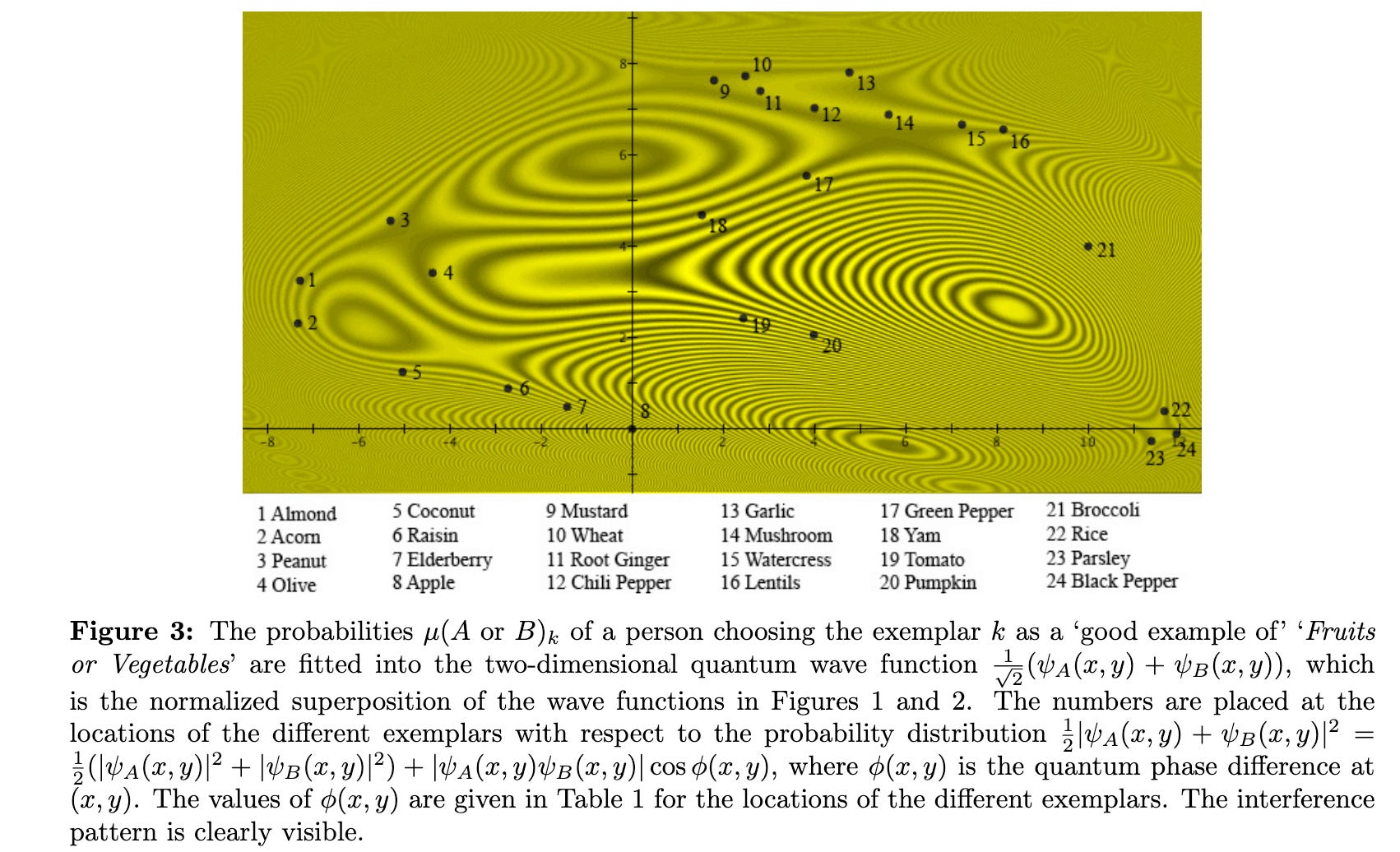
This means that some concepts are ‘stronger’ than we would expect them to be, and others are ‘weaker’. In other words, while every one of these things (except #14, mushroom) actually is a plant, and most of them are botanically fruits, our everyday concepts of them as Food or Fruits or Vegetables cluster based on our social and cultural learning processes. Mushrooms grow out of the ground and don’t move, like plants, and so our analogy-making processes cluster them with plants, even though they are not green. Most “fruits” are sweet on the tongue because they have simple sugars in them.
So yeah, the world is in fact big and strange, but it’s OK. Don’t panic.
Here’s a cup of tea. Do you have your towel?
