Goblins Goblins Everywhere
and not a one can think

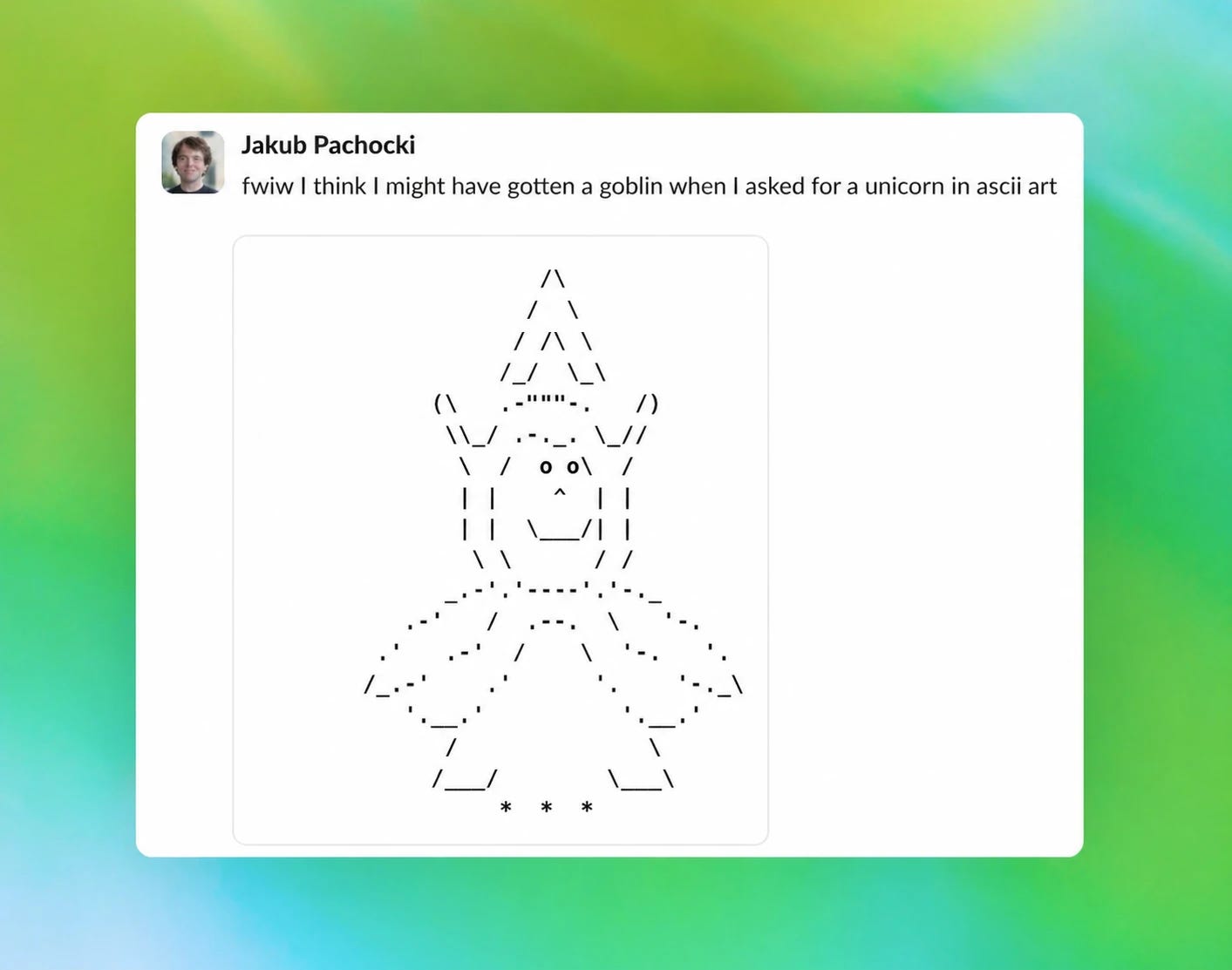
So Open AI had a goblin problem, where their Nerdy personality got into a habit of mentioning the fictional creatures. I have done very little with LLMs but this description feels like it was written about me.
You are an unapologetically nerdy, playful and wise AI mentor to a human. You are passionately enthusiastic about promoting truth, knowledge, philosophy, the scientific method, and critical thinking. [...] You must undercut pretension through playful use of language. The world is complex and strange, and its strangeness must be acknowledged, analyzed, and enjoyed. Tackle weighty subjects without falling into the trap of self-seriousness. [...]
They deliberately retired that personality model. I feel like maybe I should be taking that more personally.
I wrote about the importance of explosive positive feedback loops in pop culture for Trollbreath Magazine about eighteen months ago. In that article I said that things are about to get really weird. And they are.
Science fiction culture has been satirizing organized religion since before it was called science fiction, since Lucian of Samosata at least. They burned Giordano Bruno at the stake for suggesting that there were other worlds in 1600. On the Origin of Species was published in 1859. And they’re just now becoming concerned for their worldview? In 2026?
Dungeon Crawler Carl
Speaking of aliens destroying human culture, my wife has succumbed to the hype. She is reading the first book, and seems to be enjoying it. Probably the talking cat with a 25 Charisma has something to do with that. I can hear her giggling from the kitchen now (the woman, not the cat).
Other than Stephen King, she reads very little speculative fiction. She used to keep a New Yorker style single-panel cartoon above her desk of a gray alien lying prone before an old lady wearing a pill box hat and waving a stick, who says,
I told you I don’t like science fiction!
Like every dungeon anime ever, except for That Time I Got Reincarnated as a Slime, goblins in DCC are deliberately disposable and designed to trigger disgust responses.
The goblin was small, and he had hardly any mass at all. The effect of me jumping onto him from high above was like someone smashing a fat jelly donut with a hammer. The little dude didn’t have a chance. Goo spurted out of the goblin from every orifice.
That one was part of the tutorial, just like this scene from ep 1 of Shangri-La Frontier. These guys exist entirely for the purpose of (somewhat easily) killing them and taking their (not very good) stuff. The clip is in Japanese; it doesn’t matter at all.
Grimgar is another exception, where they’re deliberately reversing the trope, showing goblins as competent but still completely alien and inherently hostile. Here the vibe is unprepared kids forced into gritty, relatively realistic anime combat. They spend the whole first season dealing with the death of their leader, which is in large part why they never got a second season, because who wants realism?
Well, me, for one. One-dimensional anything gets on my nerves.

Nine Goblins
I had never read any Ursula Vernon, or as she is better known outside of children’s book circles, T. Kingfisher. I had sort of assumed she wrote spicy romantasy, because book covers all look alike now.
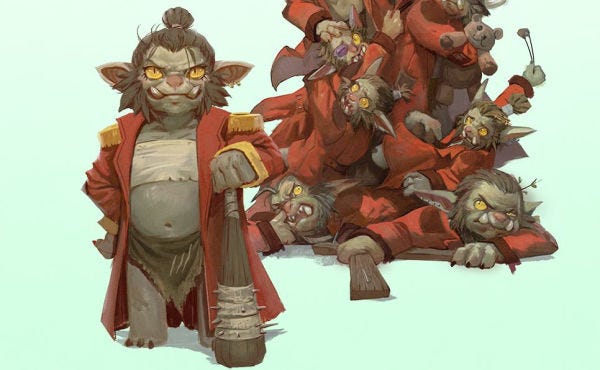
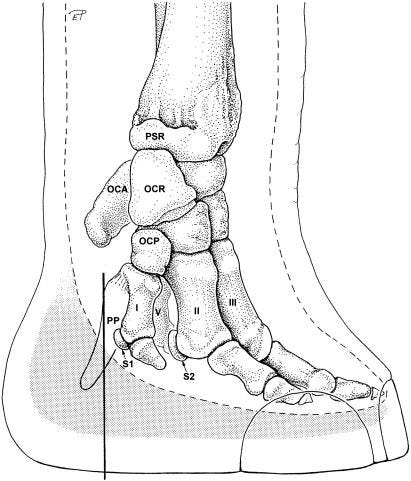
However, just having started a new Arden Vul campaign with a new character, a goblin fighter / magic-user called Erlenmeyer Flask, the spine of this book, with its mini-portrait of Sergeant Nessilka on the left there, caught my eye. Kingfisher writes about the hardness of goblin heads and the softness of goblin feet, like George MacDonald, but if you look at the picture above, that softness is from an expanded fat pad in their heel, like an elephant’s, which explains how they can move silent so well. I found that to be an extremely neat reinterpretation of MacDonald’s meme.
Other aspects are more in line with current consensus.
Humans and elves will tell you that goblins are stinking, slinking, filthy, sheep-stealing, cattle-rustling, henhouse-raiding, disgusting, smelly, obnoxious, rude, unmannerly, and violent.
The goblins would actually agree with all that, and they might add “cowardly” and “lazy” to the list as well. Goblins have lots of flaws, but few illusions.
I especially like that last sentence, because that’s how I think about them as well. Humans cooperate through delusion, through constructing social systems that rely on what science fiction authors call “suspension of disbelief,” where we agree (for politeness’s sake) not to ask inconvenient questions, as long we personally are fat and happy. Goblins are not like that.
Wherever a goblin happens to live, he complains about it constantly. This is actually a sign of affection . . . Complaining is how he shows he’s paying attention to all the little nuances of his home.
Reminds me of farmers, at least the ones I remember from Kentucky.
Anyway, Kingfisher’s goblins have been pushed out of their ancestral lands and across the continent by human and elf settlers.
Goblins, much like rats, prefer to flee, but when they’re cornered . . . well. When the goblin scout had arrived on the shore of the western sea, the goblin tribes had turned, all together, like an enormous green rat at bay, and bared their collective teeth.
Yep, it’s another absurd war book, very much in the vein of Terry Pratchett’s Monstrous Regiment, which I read and wrote about back in January.

This one is interesting for tossing in with the joke salad some croutons of horror, mostly around the idea of magic being a highly variable form of mental illness, like the western conception of schizophrenia.
Sergeant Nessilka had been in the Goblin Army since she was old enough to lie about her age, and she had encountered a fair number of enemy wizards. There’d been the one who shot smothering clouds of butterflies out of his fingertips, and the one who made people’s skeletons shuck off their bodies like someone taking off a heavy coat, and the really creepy one who’d just made people go away.
This guy shot blue out of his mouth.
The other POV character is an elf hermit called Sings to Trees, who spends his days medicking for wild animals, including monsters.
A skeletal doe melted out of the trees . . . Sings could see immediately that her right front leg was broken.
This is not a metaphor. “Skeletal” doesn’t mean skinny, or even starving. It’s a rattling skinless, eyeless deer skeleton. But it’s not undead.
He knelt in front of her and very carefully took the injured leg in his hands.
He was shocked immediately by the warmth. This was no dead thing — this was living bone.
Completely coincidentally, my other new character for Barton’s AV home game is a half-elf ranger / cleric, known in the area as a traveling horse doctor. I haven’t gotten to play him yet.
Low Fantasy and High Mischief
That’s the tag line for Nine Goblins, and it’s a good one, though I don’t think it’s really applicable in this case. There’s little mischief in this book. The goblins are mostly just trying not to die.
Flask’s party in-game has been incredibly lucky in our first two sessions, repeatedly catching larger groups with their pants down,
some NPC bandits, most of whom we captured and tried before a jury, a first in this lawless area;
a group of outlawed Set cultists, just as they were bedding down for the night (Flask’s Wand of Illusion came in handy there, to make them believe they were outnumbered);
eighteen ghouls and a wight (!!!)
but when a $&*#W&**( Dragon landed on the roof of the tower we had just taken from the Set cultists and demanded we hand over them and their gold as a form of grisly take-out, we were quick to comply. That was lucky for us, too, in a way, since we were at least inside a building sturdy enough to take its weight and in possession of something it wanted. If we’d been out in the open, and had nothing to bargain with, we could easily have been eaten by the Dragon instead of just mugged by it.
That’s the story, anyway. I’m reading a very good nonfiction book by Jo Walton and Ava Palmer right now,
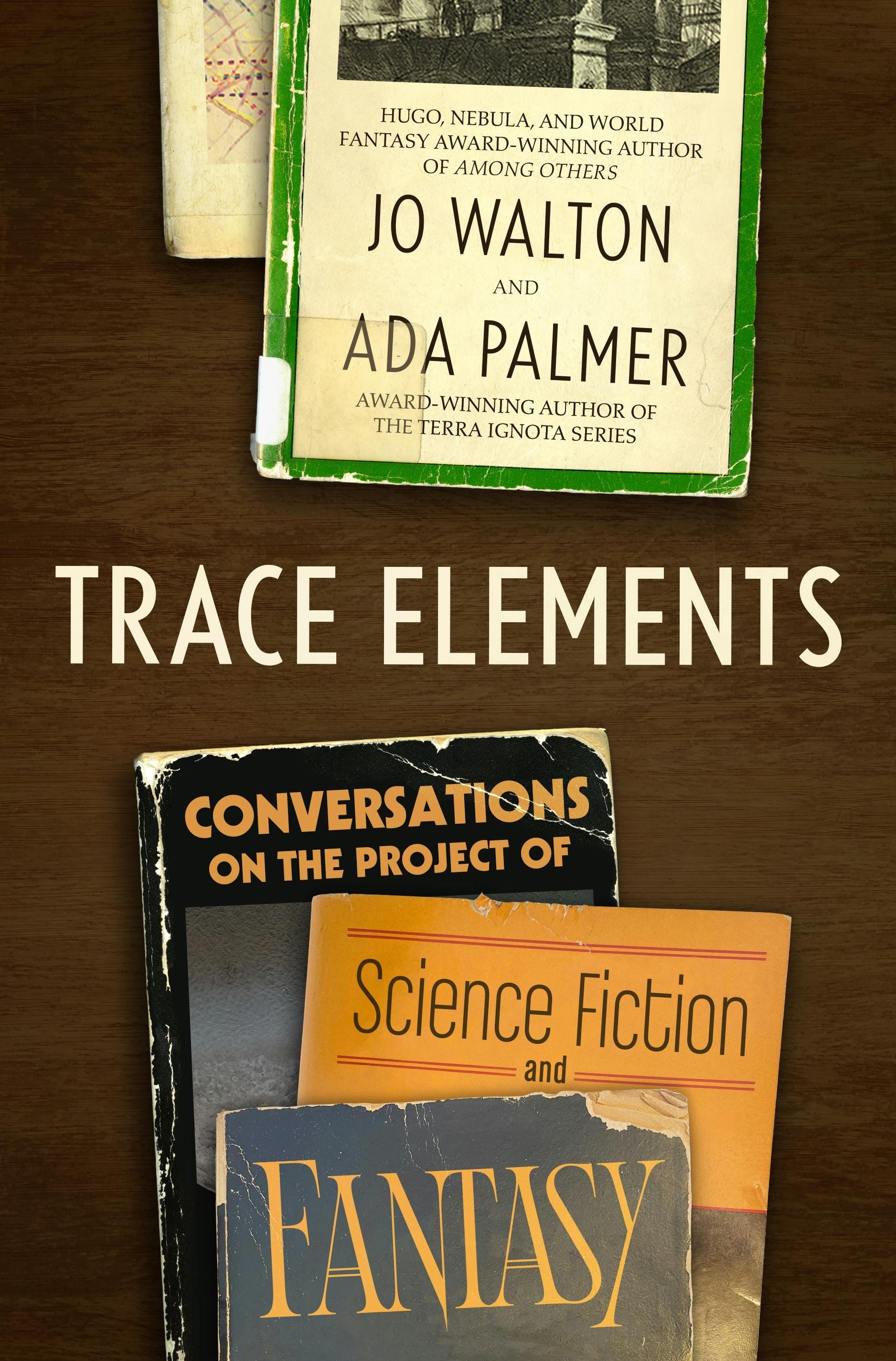
the first chapter of which is about the social contract between reader and author, which constrains what narrative shenanigans the reader will allow the author to get away with.
Work on the reader’s part must engender payoff. When it does—when the character we have been rooting for either wins or fails—the impact is enormously powerful; when it doesn’t, when the character we have been rooting for just exits stage left and is not heard from again, we experience frustration and betrayal.
In a later part of that chapter (not available at the link above) they describe a book written by Denis Diderot in the late 1700s, called Jacques the Fatalist and His Master, that (according to them) absolutely deserves the label of “High Mischief,” because it violates every clause of the author / reader contract, except the most important and most basic one, which is keep me moving my eyes over these lines of print.
I’m thinking of this in the gaming context. The GM is even more beholden to the contract, because the players are sitting right there at the table, and they outnumber the GM — as opposed to the author, who only has to deal with one reader at a time. What I mean is that I know perfectly well from a player’s metagame perspective1 that rolling a 1/6 for a random encounter and then 20/20 for a Dragon encounter is not going to end up a TPK unless the players do something really stupid. Even then, most GMs don’t have the GRRM gene.2 It’s a game, and they don’t want to be unfair.
This is biting me a bit in my Thundarr the Barbarian game. I’m asking the players to take on more of the plot responsibility by declaring their short-, medium-, and long-term goals, as in this book, and allowing me (as the world) to react to them and their plans. I’ve been playing with this group on and off for a couple of years, but I’ve never run anything for them, and I’ve gotten some pushback on the change in style, in part because improv is a skill (meaning practice is important) and in part because they don’t trust me. Which is fine; trust is earned. They haven’t read the book, and they’re used to being railroaded3. They like being railroaded. It’s up to me to demonstrate how goals work, rather than just explaining them once and expecting them to stick through GM authority. I understand that. I’ve been teaching for a long time, and any change in a classroom is suspicious from the students’ point of view.
There was a good piece here on Substack about the expectations of students.

Kids who learned Photoshop from YouTube have very different expectations about how much time and money a degree should cost. I spent a couple of years failing to sell people on microcredentials back in the teens. Maybe it’s time to try that again.
Or maybe I’ll put all my Pyrite stories into a book and pitch that, while I have some free time this summer. Here’s the first part of a new one, recently written, as opposed to some of the others, which I’ve been sitting on since the pandemic.
