Appendix R
my own private Duncan Idaho

Dunk & Egg (Yay!)
HBO has finally gotten around to my favorite set of stories from Martin’s Westeros writings, starring Ser Duncan the Tall and his shorter, smarter squire. In D&D terms, Duncan has a low Intelligence (less because he is stupid than because he is naive and uneducated), a high Wisdom, and a middling Charisma. At least that’s always been my interpretation from reading.
After the relative success of last week’s Appendix N post, I’ll try to give some idea of my own personal influences. I don’t only play fantasy games, and D&D is not my favorite even within that narrow category, but that’s the prompt I’m responding to. What follows is more or less chronological within broad overlapping categories.
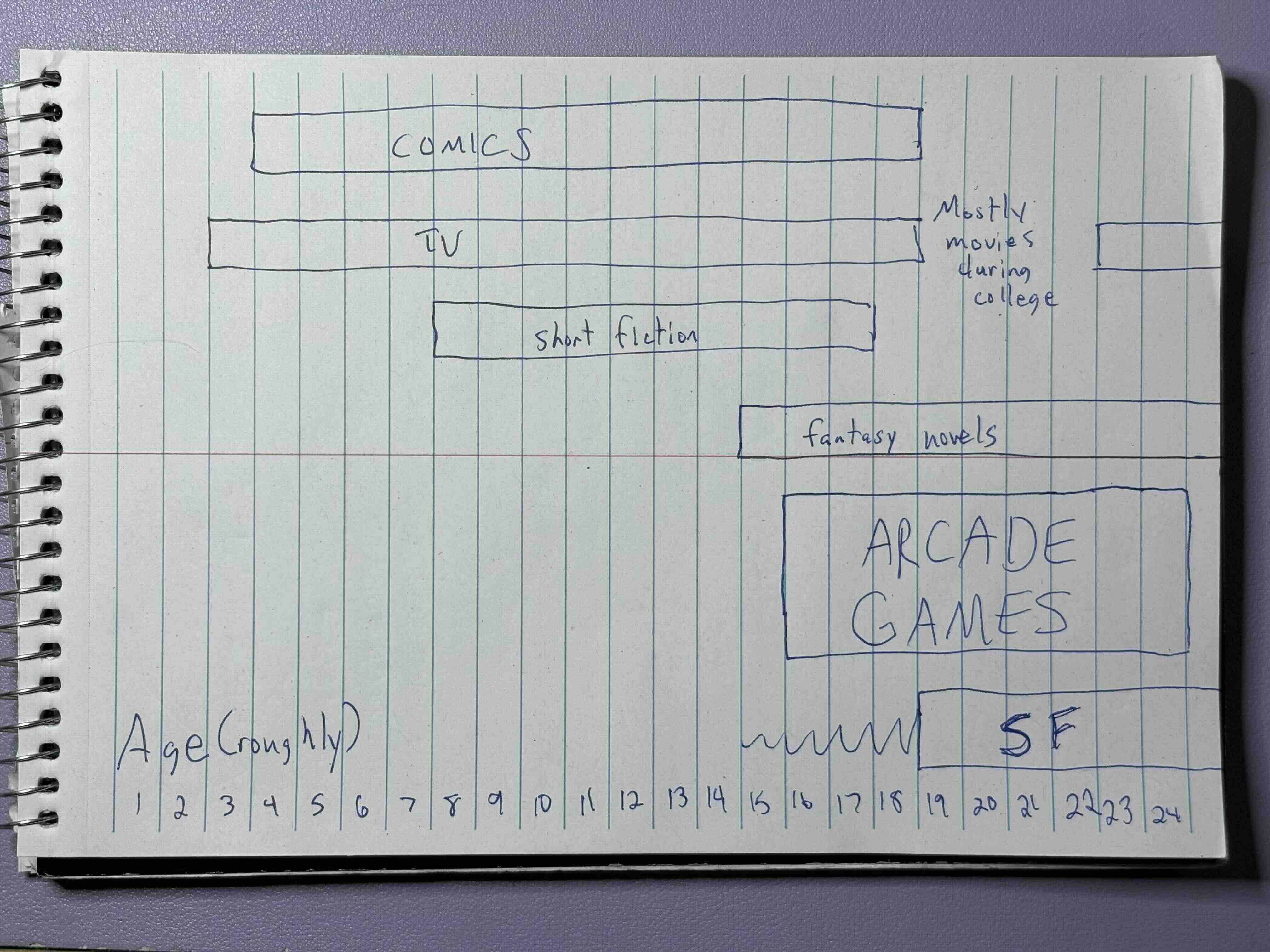
Obviously this was not all of my reading, or the World Book Encyclopedia and a lot of other nonfiction (even including sports, ewwww) would be here, especially natural histories about animals (and monsters), along with dozens and dozens of kid detective books.
First and foremost, comics
TSR did produce a Marvel Superheroes game, but it has a much different vibe than D&D. You aren’t breaking into villain lairs to murder them and steal their villain stuff. So this will be confined to a tiny slice of the comics I spent most of my childhood on.
Elfquest by Wendy & Richard Pini. The original creator-owned comics were very cool back in the 80s, and had me making notes for knock-offs, but the real debt I owe them was for the two Blood of Ten Chiefs prose anthologies, which eased me into reading fantasy fiction, specifically short fiction1. I see on the website that there are now graphic adaptations (or maybe extensions?) of these.
George Perez & Marv Wolfman’s Wonder Woman. DC’s other sword & sorcery titles like Arion of Atlantis and Arak, Son of Thunder, both spin-offs of The Warlord, never much appealed to me. I’m not sure why2. But when Perez & Wolfman went back to Wonder Woman’s roots in Greek mythology, I was hooked. I think this was about when I found Edith Hamilton’s collection of retold myths, which also had a Norse section at the back.
Walt Simonson’s Thor did a similar thing. Where Kirby’s Asgard was a very MCU thing full of gleaming golden towers, Simonson went all fairy-tale, with the Warriors Three hanging out in thatched-roof taverns, even turning Thor into a frog at one point, which as a teenager I found simultaneously dumb and funny. Also, Beta Ray Bill (!?!).
Coyote. Kind of a superhero, kind of not, with the trickster vibe. Another creator-owned book from the 80s. In any case, it continued my obsession with Native American mythology, which started with Westerns on TV and a nonfiction biography of Crazy Horse that led to my first superhero creation in 7th or 8th grade, which I used in a hand-drawn comic for English, and to my first 10-page research paper in American History.
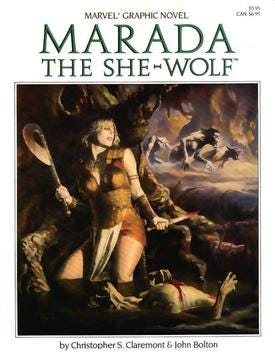
Marada the She-Wolf: I never read much Savage Sword of Conan or Red Sonja. John Bolton’s paintings for this graphic novel were so gorgeous I didn’t care about the story, which was written by Chris Claremont of the X-Men.
Then Television
The Wonderful World of Disney
In the 70s they were really just playing clips of their old stuff as advertisements for the theme parks, but there were some good clips: the Headless Horseman3 chasing Ichabod Crane through the woods, the amazing sorcerer’s battle from The Sword in the Stone (which I later learned was actually pretty faithful to the novel), Paul Bunyan & Babe the Blue Ox.
The Hobbit
Rankin-Bass was mostly known for stop-motion holiday specials when I was really little. And some of that did eventually make its way into undergrad gaming. Yukon Cornelius was a dwarf prospector in at least one D&D campaign.
Rankin-Bass did their watercolor wash version of The Hobbit, which I saw on its original broadcast. I saw part of The Return of the King a few years later. I knew about Bakshi’s rotoscoped version from reading about it in some grocery-store magazine but never saw it (or Fire & Ice) until college. Likewise the really excellent Rankin-Bass version of Peter S Beagle’s novel The Last Unicorn (which I did read in high school).
Watership Down
This cartoon did what no other cartoon on network television at the time dared to do. It showed blood, and pain. Despite the fact that it was about psychic rabbits who could talk, to a farm boy steeped in death it was the most realistic thing I had ever seen fantasy do. Mildly traumatic and transformational.
Dungeons & Dragons
This cartoon was such a disappointment to me. It hit me at exactly the wrong moment. I wanted to like it — was desperate to like it — but they had these cool superhero-level weapons, and it seemed like all they ever did was run away4. I have recently re-watched a few of the early episodes, and that impression has not changed.
Thundarr the Barbarian
Now yer talkin’! Post-apocalyptic designs by Jack friggin’ Kirby! The fabulous Sun Sword! Princess Ariel, who was not a useless Disney princess but a powerful sorceress in her own right. Ookla the Mok, who was big and angry like Chewbacca but actually available to me, whose family never went to the theater to see movies, every Saturday morning. I never happened to see any of the reruns they mention in the video below, and I wonder how my memories would hold up.
I’m slightly less curious about the coming comix from Dynamite.
He-Man and She-Ra
I was really too old for these by the time they came out. I still watched them but made fun of them mercilessly, especially the artless generic character names and the moral lessons at the end.
Weekly Reader short fiction
There was this undercurrent of things like “Arena” (basis of the Gorn episode of original Star Trek) and Kurt Vonnegut’s “Harrison Bergeron” in my 7th & 8th grade English classes. Others that I don’t remember now, but the idea of going beyond escapist entertainment and toy commercials to saying something important (or at least interesting) with fiction was there the whole time.
Fantasy Novels
During the first three years of high school, I was mostly reading comics and classics for school, but The Princess Bride was an important departure. Of course I did not see the movie until years later.
And that’s when she put her book down. And looked at me. And said it: ‘Life isn’t fair, Bill. We tell our children that it is, but it’s a terrible thing to do. It’s not only a lie, it’s a cruel lie. Life is not fair, and it never has been, and it’s never going to be.’
Would you believe that for me right then it was like one of those comic books where the light bulb goes on over Mandrake the Magician’s head? ‘It isn’t!’ I said, so loud I really startled her. ‘You’re right. It’s not fair.’ I was so happy if I’d known how to dance, I’d have started dancing.
That one thought — from that one book — has informed so much of my gaming, my writing, and my life in general.
During my seventeenth summer, between junior and senior year, I spent six weeks at Centre College for the KY Governor’s Scholars Program, where I did not manage to fit in socially but did read an amazing number of fantasy paperbacks from a wire spinner rack in their library.
Lord Foul’s Bane, the first Thomas Covenant book. Fantasy can do anti-heroes? Cool. And the Bloodguard were magically mutated martial artists, bound by a ritual / oath, way cooler to me than the mercenary Witchers of current fashion and fame.
The Last Unicorn, by Peter S Beagle. Short, beautiful, and sad.
The White Hart, by Nancy Springer. The title and the cover are literally the only things I remember about it at this point.
The Guns of Avalon, by Roger Zelazny (my favorite!). I did not realize this was part of a series for months afterwards.
and others that I can no longer remember. When I got home, I failed my Tolkien save again by starting with The Lord of the Rings instead of The Hobbit, which is shorter and friendlier to the teen reader (at least this one). On the up side, the county library was chock full of Andre Norton’s takes on post-apocalypse fantasy, like The Crystal Gryphon, which kept me occupied for a while5. I also eventually found the third book of Zelazny’s Amber series there, called Sign of the Unicorn, and stumbled across a collection of his short stories, Unicorn Variations, in the library at school. That and the Elfquest anthologies bridged me into Thieves’ World, another shared-world anthology series which had some of the same authors and a very D&D approach.6
Video Arcade Games
I did not have a computer at home, which meant that I did not have a computer on campus. I did not play video games, other than those that required a quarter to activate them. These things were in some ways more important to my imagination than movies. My MSU gamer buddies were always doing double takes: What, you haven’t seen that!?!
Rastan
The music alone is worth a quarter.
Golden Axe
One of the few I could actually finish occasionally, I loved this game so much that I spent an entire academic year recreating Gilius Thunderhead as a tabletop character. By 10th level I had both his lightning magic (aka Storm Giant abilities from the Monster Manual, which I “wasted” a wish spell on)
control weather
call lightning
lightning bolt
control winds
weather summoning
and the 2e Tumbling proficiency that enabled his ridiculous roll-backwards-to-charge attack. The only thing I lacked by the time the campaign ended was his purple stinger lizard, which I just now learned is called a Chicken Leg Beast.

Gauntlet
What can I say? Source of endless quotes around the table game and beyond.
Green Dwarf needs food, badly.
Let’s go to White Castle.
Green Dwarf is about to die.
Green Dwarf needs Pepto-Bismol, badly.
Dragon’s Lair
which had also been a not-very-good cartoon in the 80s, because it did not have the game’s subversive feel, or its dozens of lavishly animated death scenes.
Magic Sword
This one allowed you to trade out (and level up) several different followers. Very D&D. I don’t think I realized that they had actual names and backstories. Also very D&D.
Amazon Sara, with a repeating crossbow
Ninja Gai, with bouncing shuriken
Thief Derek with grenades
Priest Ariol, whose glowing orbs do double damage to undead
Big Man Uma, whose giant axe boomerangs back to him
black-robed Wizard Niura
Lizardman Ryugo, who could level up into a flying dragon-man version
Knight Lothar
I loved it but sucked at it. Wasted a lot of quarters on that one.
Crossed Swords
Like Punchout, this game looks through your transparent knight to your various enemies, who always approach one at a time and telegraph their moves. You have a sword and a shield, plus maybe a magic button for emergencies. Timing is the important thing. Block-block-block, attack! I also sucked at this, which is why I generally prefer turn-based games.
Oddly, I am better at full-body athletics than I am at hand-eye coordination. So if Wii Sports fencing did a mod of this, I would probably love it.7 I did love their version of PunchOut.
D&D: Tower of Doom
I had already graduated by the time this one came out in 1994, but I played it a lot, years later in the emulated home version, with my kid on my lap to push the attack and magic buttons.
And Finally, Finally, Science Fiction
Three Hearts and Three Lions
I put this here, though I read it for the first time during high school. This was my absolute favorite because Holger Carlsen was an engineer who looked at fantasy through a scientific lens like a Julius Schwartz comic book character from the 60s Silver Age.
cursed gold was radioactive
burning magnesium radiates UV, which is toxic to fairies
dragons explode if they drink water (steam!)
It was an approach that didn’t try to explain away the magic like the teen detective genre did, to say it wasn’t real, but that tried to expand our conceptions to include the seemingly supernatural as a larger category of the natural.
Dune
I mean, in one sense, Game of Thrones is basically just Dune with eunuchs and incest. Noble houses and all that. And Dune fronts ecology, which has always been very important to my thinking on monsters and environments. More on that in a future post.
I know there are like 40 books in this series, but I only ever read the first one.
That gets us up through the entry to tabletop gaming, which then triggered a feedback loop, so that the influences go both ways, and I am not prepared to think about that on a day when I have grades due.
and more specifically shared world projects, something I’ve been meaning to write about for a long time.
Since such enterprises became common, the concept of the shared world has generated large masses of mediocre work, often written for hire, without much evidence of joy, or taste, or thought. But that is happily not a universal rule. Some shared worlds begin in comradeship and continue to demonstrate the pleasures of sharing. The collegial shared world is a model of the sf community at play. Good shared worlds of this sort may, we can hope, in due course drive out the bad.
especially since TIL that Arion was created by Paul Kupperberg and Jan Duursema, the same team whose graphic novel version of The Magic Goes Away I gushed about last week.
“When I steal I steal from the best.” - PK
By the way, the Headless web series is a lot of fun.
Modern D&D players frustrate me in the opposite way, by expecting to win every battle.
I find it funny that the Beast Master books, which Norton wrote as soft science fiction, with ships and guns and an alien species called the Xik, starring a Navajo named Hosteen Storm, were filmed as sword & sorcery with shirtless blondes as the protagonists. Norton was not happy with this and had her name removed from the credits.
My older brother was really into GRR Martin’s Wild Cards series, which also shared authors, but that series is about superheroes, so we’re not going there today.
Oh, wait, they did have a version of it, a third-party thing called Rage of the Gladiator, which I had forgotten all about (thanks, Wikipedia!). 2010 was after the formative period we’re talking about today. Odd how the further-back memories are more available and more vivid in a lot of ways.
Ask and ye shall receive; this just appeared tonight.
https://tubitv.com/series/300018250/thundarr-the-barbarian
Rat-men on motorcycles: "There can't be more than fifty of them; I'll be fine."