[reprint+] Intertribes
and just what is a protopia, anyway?

Aligning Incentives
Before we get started today, a quick ask. Writing a review for our new book would be super-helpful and much appreciated. I don’t get any royalties, but I do hope to work with them again, so if you DM me some confirmation I’ll upgrade your subscription.
Little Wins
This will be a short one, as I am busy working on a story for the $5k Protopian Prize, due at the end of the month. The organizers held a Zoom call of lightning talks to introduce collaborators doing projects they like, including:
JD Lauwerends of BlackSky Algorithms, which enables DIY social networks;
Jodson Graves, a former Marine doing software development around some kind of online urban-farm marketplace (?) in Louisville, KY;1
Allegra Cohen of the AI Objectives Institute, which has a consensus-building polling tool called Talk to the City, and later Yuting Jiang of Protopia Paris, which has a similar tool called Agora, based on Polis, which I’ve mentioned in this newsletter a couple of times.2
Steve Jankowski of the University of Amsterdam, who curates an archive of public-domain stories about how people in past times of technological upheaval imagined their own futures. Focused on information technologies, but broadly, including for instance a 1914 piece on spirit communication.
Luis Galvan, an artist who wrote a white paper on using blockchain technology in a different way, and who dropped some interesting catch phrases during the call like crypto is a belief-generating technology and cycles of hype. From the paper:
Existing protocols assume informed participation while providing no mechanisms for knowledge synthesis or deliberative capacity building. Complex proposals receive superficial engagement from token holders lacking domain expertise, leading to coordination theater rather than substantive collective intelligence formation.
The sponsoring organization, MetaGov, have also built a virtual Deck of Many Things, using the much older principle of randomly pairing column A (problems or goals) with column B (technologies), in hopes of sparking some creativity in my fellow authors.
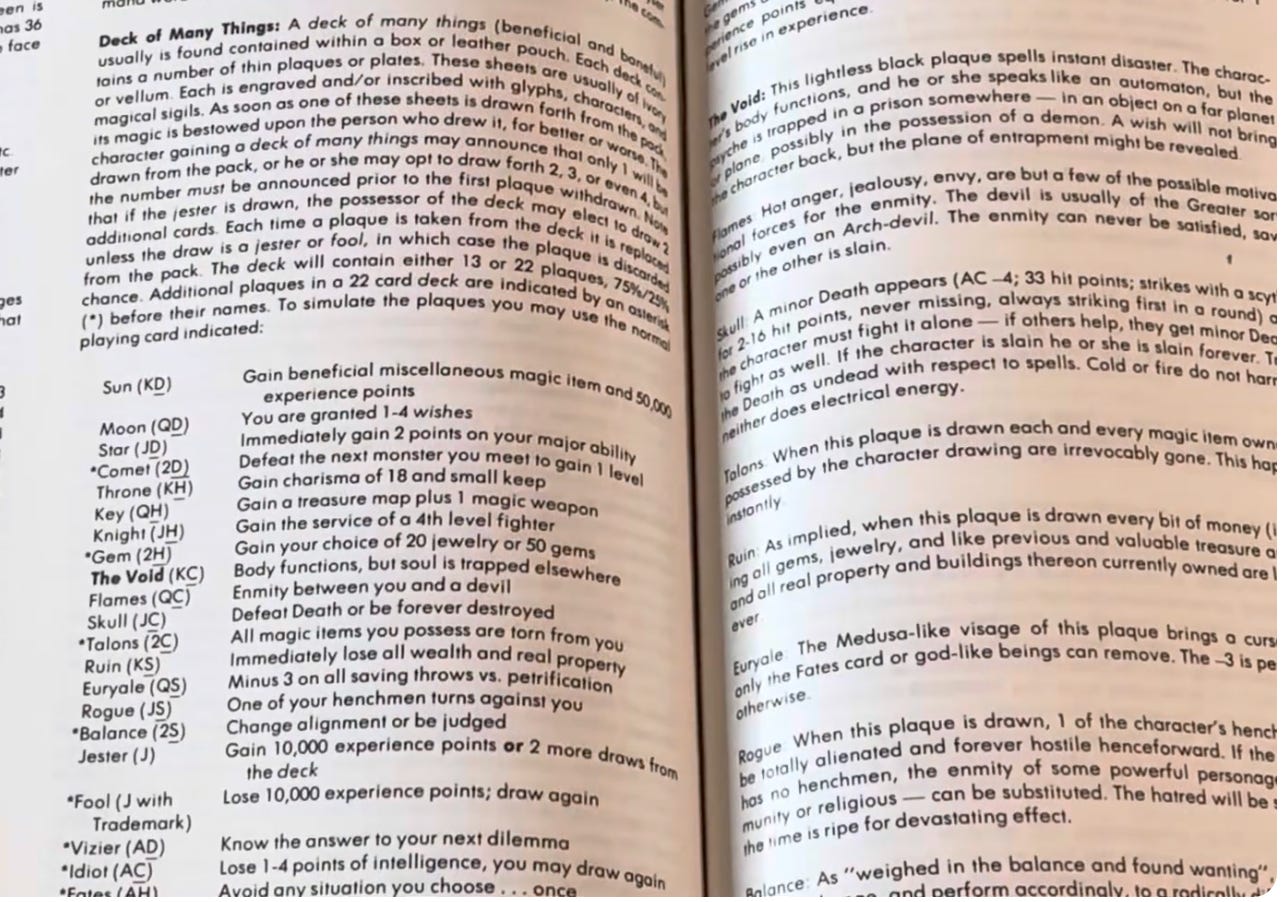
In my experience, five-minute lightning talks are not a method to develop a deep understanding of anything. They’re like speed-dating. All they really offer is contact information and the invitation to follow up. I will happily do some Q&As, if there is interest.
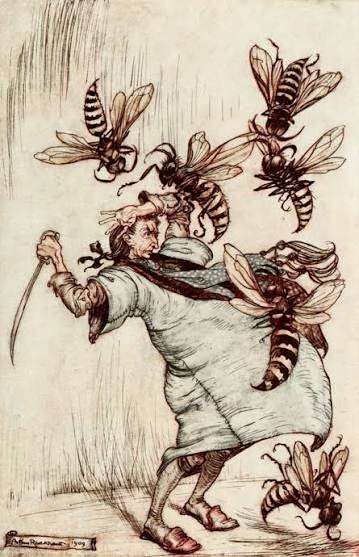
This piece from the Intergalactic Medicine Show was originally written in 2017. I reprinted it here once before, in between Trump administrations, back when there were about a third as many of you as there are now.

As then, I have pruned broken links from the text but left them in the References / Further Reading section at the bottom in case you want to track them down for yourself.
I think the basic insight holds up. Unlike Vox Machina or even the somewhat less ambitious The Mighty Nein might suggest, nobody actually saves the world (or even the realm). All-or-nothing perfection is a sucker’s game. The world changes through the accumulation of small actions, and occasionally through fire, flood, or earthquake, which we cannot control.
Oddly, this half-hour YouTube video about fantasy magic systems makes a similar point towards the end.
The archaeology of ancient magic reveals that magical practice was all about what can I do right now with what I have? A little bit of ritual technology for when the world felt too big and the levers of power were out of reach. And that’s how I sometimes feel about the environmental crisis. It’s enormous. It’s structural. And it’s way bigger than any one person can fix alone. Fixing it means working at the human scale. Small actions in the face of vast systems. And that’s how I think about Planet Wild and why I’m a member. Planet Wild is like crowdfunding for nature.
One of the complaints that came up during the lightning talks was that listeners wanted direct action. They didn’t want future tools and potential infrastructure (especially not data centers!). They wanted to feel differently about where we’re at and where we’re going. That was my interpretation, at least. Planet Wild, a German B corp that funds environmental nonprofits and shares their success stories, might be exactly what they’re looking for. I prefer the personal accountability of my local Rotary club.
But as below, we need to get beyond thinking about the One True Solution. As in another Religion for Breakfast video,
Each culture basically has one god or pantheon neatly mapped onto their geographical region. Now, that makes it easy for us to follow as viewers and readers, but compared to the chaotic reality of real world religions, it feels thin.
which, honestly, is the point. Artists compress and simplify to support an argument or a personal point of view. I’ll be doing the same in whatever I manage to spin out for this contest. Hard to do otherwise in 5,000 words . . .
Wish me luck!3
Imagined Nations
“How many Centauri does it take to screw in a light bulb?
Just one, but in the great old days of the Republic,
hundreds of slaves would change a thousand light bulbs
at our slightest whim!”
- Ambassador Londo Molari, Babylon 5
“The American dream is dead.”
- Donald J. Trump, 45th (and now 47th) President of the United States
In my January column, I made a pun, which the editor changed on the website version to “imagined notions,” which makes just as much sense, grammatically and contextually, but loses the joke. I am not complaining about this. When I finally noticed the change, months later, it led me to do a search for that phrase, “imagined nations,” to see if it was a cliché or something. Was I being ignorant, when I had thought I was being clever (not an uncommon occurrence, really)?
What I found was the concept of imagined communities, based on a thirty-year-old book of the same title by Benedict Anderson. He said that nationalism is socially constructed, based on shared media, especially media in a shared language. Those activists who want to make English the official language of the US are trying to strengthen the ties between English speakers by excluding speakers of Spanish and Vietnamese and Klingon. The two effects are sides of the same coin. In order to define an inside, there must be a boundary, and anything or anyone beyond that boundary must be defined as outside. This is true at the cellular level, at the level of an individual body, and at the level of a social community.
Science fiction, from Babylon 5 all the way back to Gulliver’s Travels, has looked at nationalism as an inherently bad and dangerous thing, a fake and false thing, a grand delusion that prevents rational, universal cooperation. The war between the two tiny-people nations of Lilliput and Blefuscu grew from the most trivial disagreement Swift could come up with:
“This, however, is thought to be a meer Strain upon the Text: For the Words are these: That all true Believers shall break their Eggs at the convenient End: and which is the convenient End, seems, in my humble Opinion, to be left to every Man’s Conscience, or at least in the power of the Chief Magistrate to determine.”
Anderson, on the other hand, emphasized the creative aspect of “imagined,” as in creating a real new thing rather than lying about something that never existed and never will. He wrote about the “utopian elements” of nationalism, which encourage good behavior among the members of that nation. Later, evolutionary biologists like DS Wilson would agree that the point of religion is also to increase cooperation inside the group; writing off those outside the group is a regrettable but unavoidable cost of the increased cohesion. Alan Moore, trickster magician that he is, merged these arguments in Watchmen, saying that the only viable way to get human beings to cooperate is to define an external enemy, even if that enemy has to be a made-up interdimensional monster, and even if some of your own people have to die to sell the lie.
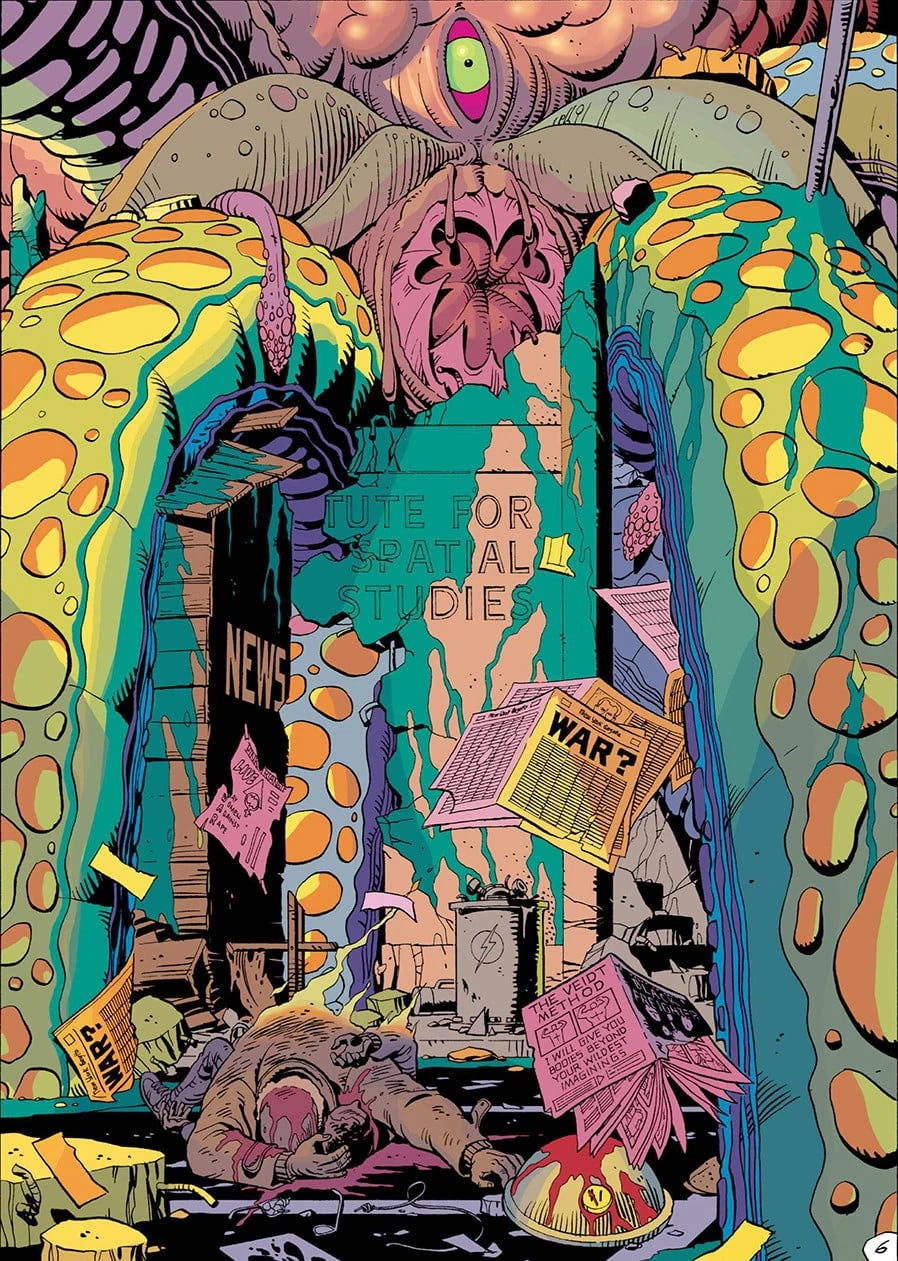
There’s now a great deal of research implying that the humanist dream of universal community is not realistic when actual humans are involved. We can only carry a limited number of names, faces, and social profiles in our tribal primate brains (ironically, sociopathic dictators often seem to carry a lot more). According to this research, it’s very difficult for us to generate the same level of concern for people we don’t personally know. While a photo of an individual child can fool us into feeling as though we know that individual, photos of groups as small as two are less effective at provoking charity (yes, they test these things).
Buddhists would disagree, saying that compassion is like a muscle that requires practice to activate and strengthen the neural circuits responsible, which they do in meditations on metta, or loving-kindness. The rituals and founding myths of nation-states are another way of trying to hijack our emotions to allow us to cooperate with people we don’t know and trust (often for the purpose of screwing over other people), to give us an illusion of control over the rising and falling tides of history. Economics is yet another attempt, but targeting instead our calculating, selfish egos. All of them work to some extent.
Even scientists, supposedly some of the most objective people around, group themselves into little feuding tribes. I do an exercise with my Governor’s School students where I put the following list on the whiteboard and then give them dry-erase markers and ask them to label it with the names of sciences that study these levels of structure (physics, psychology, etc.).
Planet
Biosphere
Ecosystem
Community
Species
Population
Individual
Organ System
Organ
Tissue
Cell
Molecule
Atom
The list could be extended on either end; I just run out of vertical room on the board. It serves as a starting point for the students to discuss the limits of various scientific fields while they’re drawing. What we end up with is a fantastically colored Venn diagram, illustrating that there’s only one physical reality, described in many different ways at different levels. All of our various scientific communities of practice are just that—social communities based on shared vocabulary. Each group is studying some subset of the same integrated system. That’s why we call it a universe.
One of the things that comes out of the exercise is the realization that the same scientist can belong to multiple communities. As a neuroscientist, I get to study bits of chemistry, biology, psychology, computer science, and the humanities. My strongest tribal affiliation is with biology, I suppose, but my emotional attachments to any discipline are probably weaker than those of many other scientists. My time commitments to individual professional societies and such are measurably smaller, because I do a lot of different things. There are both benefits and costs to my approach; one of the main costs is that the academy rewards those who stay in their silos and specialize, because it minimizes competition with other members of the department. Intellectual nomads like me tend to step on people’s toes as we’re wandering around in the dark, no matter how nice we might try to be about it.
So it’s with hopeful skepticism that I propose a social organization I call INTERTRIBES, as in tribes that overlap one another like a Venn diagram, or like chain mail. With a few exceptions like dual citizenship, our current hierarchical models of personal identity nested into society are about complete belonging. You can only belong to one species, as a matter of biological definition. I see that as a problem, where culture is concerned. We may have exhausted the possibilities of emotional and economic hacks designed to expand our personal bubbles of cooperation until they merge into a single perfect utopian bubble that encompasses the whole species, or the whole cosmos.
I want to explore instead how partially overlapping social groups can strengthen cooperation at a larger scale. In other words, I want to ditch the idea of perfect community and see if we can achieve “good enough” cooperation by having everyone belong to multiple groups, and emphasize friend-of-a-friend relationships. The answer has always been to increase in-group cooperation, in bigger and bigger groups. What if another, more practical answer is to decrease it in-group, in order to have more room for between-group cooperation? Just to toss out a frinstance, what if everyone became somewhat competent in five randomly chosen languages?
In terms of academic research, I can see this being a good question for simulation to tackle, similar to what other groups are doing for religion. How many in-group and between-group links are optimal? What’s the optimal ratio of link strengths? It could also make for some pretty cool stories. After all, what’s a story but a simulation, involving interacting agents, described in words instead of numbers?
Randall Hayes, Ph.D., read “The Man Without a Country” in grade school, and totally missed the point. Sorry, Mr. Hale.
REFERENCES
http://www.intergalacticmedicineshow.com/cgi-bin/mag.cgi?do=columns&vol=randall_hayes&article=013
https://en.wikipedia.org/wiki/Imagined_community
https://www.usenglish.org
http://www.pbs.org/speak/seatosea/officialamerican/
https://www.uio.no/english/research/interfaculty-research-areas/culcom/news/2005/anderson.html
https://en.wikipedia.org/wiki/Fictional_language
https://www.go90.com/videos/7EaSPgDu2KA
It’s one thing to say that a show was ahead of its time, but season 1 of Bab 5 is downright spooky, given where we are right now as a country.
http://www.newyorker.com/magazine/2015/08/31/the-fearful-and-the-frustrated
“The longer I stayed, the more I sensed that my fellow-attendees occupied a parallel universe in which white Americans face imminent demise, the South is preparing to depart the United States, and Donald Trump is going to be President.”
https://evolution-institute.org/this-view-of-life/
Just click the ‘religion’ box to see several dozen short articles.
http://www.believermag.com/issues/201306/?read=interview_moore
http://www.bbc.com/culture/story/20160809-watchmen-the-moment-comic-books-grew-up
https://www.jstor.org/stable/23580382
“The Humanist Dream: Babel Then and Now” requires a free registration to read it. JSTOR allows you three free articles at a time, a take on the freemium model I’ve not seen before.
https://fivethirtyeight.com/features/how-many-people-can-you-remember/
http://www.npr.org/2011/06/04/136723316/dont-believe-facebook-you-only-have-150-friends
The Guardian, on the other hand, relies on donations to keep all of their content free.
https://www.theguardian.com/voluntary-sector-network/2013/jul/31/images-charity-websites
http://www.buddhanet.net/metta_in.htm
https://en.wikipedia.org/wiki/National_myth
https://www.jacobinmag.com/2014/11/americas-founding-myths/
Of course, the Evil Empire and the Noble Savage are also simplifying myths. This article also refers back to the Mound Builders of last month’s column.
http://www.academia.edu/6159236/Myths_History_and_the_Construction_of_National_Identity
https://www.firstthings.com/article/2006/03/the-founding-of-nations
“The human need to encompass life within the framework of myth is not merely a longing for pleasing illusion. Myths reflect a fundamental human need for a larger shape to our collective aspirations. And it is an illusion to think that we can so ignore that need, and so cauterize our souls, that we will never again be troubled by it.”
http://www.intergalacticmedicineshow.com/cgi-bin/mag.cgi?do=columns&vol=randall_hayes&article=002
As I wrote in column 2, money is another route to the same goal.
https://en.wikipedia.org/wiki/Community_of_practice
https://www.theguardian.com/us-news/2017/apr/25/us-politics-kansas-election-red-state-blue-state
Sarah Smarsh agrees: “Contrary to popular narratives, you can be a progressive populist, a wealthy and college-educated Trump supporter, a rural laborer of color, a provincial urbanite, an open-minded midwesterner.”
http://www.hhmi.org/biointeractive/niche-partitioning-and-species-coexistence
Biologists call this strategy niche partitioning, and in nature it can get pretty extreme. Parasites can specialize not just to individual species, but down to the level of individual organs.
http://www.newyorker.com/science/maria-konnikova/social-media-affect-math-dunbar-number-friendships
Chemical hacks might be a different story.
http://nautil.us/issue/17/big-bangs/to-understand-religion-think-football
An interview, not a typical article, but fascinating. Discusses religion generally and through a case study, a new religion called Kivung in Papua New Guinea.
http://nautil.us/issue/48/chaos/the-case-for-less-solidarity
http://nautil.us/issue/45/Power/atheism-the-computer-model
The title is a bit misleading, as it is actually a profile of the Modeling Religion Project, which goes way beyond atheism.


Lots to contemplate, Randall. Particularly like “good enough” rather than utopian idea of universal community. Also appreciate your crossing over into multiple disciplines. “A jack of all trades is master of none, which sometimes is better than master of one”.
Coincidentally, there appears to be a mushroom that specifically causes the user to see tiny humans.
https://nautil.us/hunting-for-a-new-hallucinogen-in-the-lilliputian-psychedelic-1282565