Grimsley Grue
a creative notebook entry

New Short Story Out on Tuesday!
You can pre-order Oddity Prodigy’s new collection Tales of Steel and Sorcery here. I have a Nachtigall story in this one. I was also in their previous anthology Bright Mirror, with a Jules Verne-inspired piece of cozy SF (though I didn’t know that phrase when I wrote it).
Atlas of Deep Ones has been climbing the ranks on Amazon, which is unfortunately the only place it is available at this point. I am about 2/3 of the way through Derrick Palmer’s book about successfully unionizing an Amazon warehouse on Staten Island. That book is available on Amazon, but also other places. I actually got my copy at Scuppernong Books downtown, the same day I toured the Kress building.
The book is a low-key manual for how to run a campaign, full of anecdotes about what did and did not work in their successful effort and in other efforts in Alabama, Kentucky, and other places.
But one of the problems they had in Kentucky, in my opinion, was that they relied on too many salts. Buildings don’t get organized from the outside in. You’re never going to win over mostly Black and brown workers by relying on a bunch of outsiders from white leftist groups from other states.
My experience is with a large warehouse, where being able to congregate in a break room is essential if you’re going to reach workers throughout the building. Break rooms are also important in smaller shops, like Starbuck’s or Trader Joe’s, but these situations are different because you may have other opportunities to reach workers throughout the day as well.
Well, my experiences as a tabletop gamer may be less immediately important, but they’re what I have to share at this point in my lazy Lecturer life. I’m also of the firm belief that every real-world accomplishment starts as an idea, a fantasy, a story some reformer or entrepreneur tells internally enough times that it eventually spills over.

Earth Day started the same year I was born, 1970. It didn’t exist before that. There’s something inspiring in the thought that we can just start something, and it might grow into a worldwide phenomenon.
So here I am, documenting my process as it happens. Enjoy.
I happened to be reading something from a new follower, GMaia,

who insists that RPG characters should have a backstory, for moral reasons.
If a character dies because they stayed true to their values, that feels right. Not comfortable, not pleasant, but right… to a certain extent, even great. The satisfaction doesn’t come from survival, it comes from coherence: from knowing that the character reached the only conclusion their moral structure allowed. In that sense, a meaningful background doesn’t make loss harder, it makes it meaningful.
Morality and meaning are not my first concerns in games.1 I like being surprised by what my characters do. I posted a rant

where I described the breaking of one version of Cap Doffer’s secretary Laudanum.
I had absolutely not been thinking of her as a villain, not even a potential villain. I had been thinking of the dark god as another metaphor for addiction, one that she would likely overcome in short order with the help of her new friends. But then Cap died, and the party callously abandoned his remains, and her. Like any good Batman character, she snapped, and her arc changed again, like one of those out of control splines in the Rocket Racing workshop I did at UNCG a few weeks ago.
I grew up with comics (including What If . . . ?), so I have a deep affinity with the multiverse idea that yes, decisions have consequences, but also that the world system is bigger than any individual’s decisions. It will continue long after I am gone.
All that is to say sometimes I do backstories, if inspiration strikes, and sometimes I do not. I have definitely seen far too many of those undergraduate backstories that try too hard make the character in question important, a half-Elven double princess whose dueling scar only enhances her beauty, or whatever.2
So today I want to offer a window into how random memes combine in the whirling blender-blade maelstrom of my brain to produce The Funky Cold Medina.3
The girls is all jockin' at the other end of the bar
Havin' drinks with some no name chump
When they know that I'm the star
So I got up and strolled over to the other side of the cantina
I asked the guy, "Why you so fly?" he said, "Funky Cold Medina"
The Boundless Deep: Young Tennyson, Science, and the Crisis of Belief
by Richard Holmes
I’m not a poet and don’t know much about poetry. My general impression is that Tennyson is considered pretty square these days. But his early poem “The Kraken” is Romantic in tone and damned near Lovecraftian in subject matter,
Below the thunders of the upper deep,
Far, far beneath in the abysmal sea,
His ancient, dreamless, uninvaded sleep
The Kraken sleepeth: faintest sunlights flee
About his shadowy sides; above him swell
Huge sponges of millennial growth and height;
And far away into the sickly light,
From many a wondrous grot and secret cell
Unnumbered and enormous polypi
Winnow with giant arms the slumbering green.
There hath he lain for ages, and will lie
Battening upon huge sea worms in his sleep,
Until the latter fire shall heat the deep;
Then once by man and angels to be seen,
In roaring he shall rise and on the surface die.
except that in Lovecraft it is the people that would die (or go insane), not the monster.
The book is a biography of Tennyson’s life, not just his ideas, so we learn that young Alfred’s father was an abusive alcoholic who hated his career as a rural cleric. We learn that one of his many brothers was confined to an asylum for his entire adult life. We learn that as a college student Alfred was strong enough to pick up and carry a donkey that was threatening to disrupt a Sellwood family picnic where he was a guest.
During this turbulent early period Tennyson’s thought and poetry were fired and animated by the new science and the new scepticism; by ideas of geology and deep time; by the vastness, beauty, and terror of the new cosmology; and the challenge of social revolution and women’s education. But beneath all these Tennyson was driven by the emergence — or eruption — of three new and fundamentally transformative ideas from science: that of biological evolution, the godless universe, and planetary extinction.
The whole idea of extinction — that the by-definition benevolent Christian god would allow whole species to simply disappear — terrified young Victorians (says the author) in something like the same way that sensitives of my generation felt about growing up under the threat of nuclear war, or that my kid’s generation feels about climate change.
Tennyson’s interests in science started early with direct experiential roamings through the country and out to the beach, though he also read a lot of books, including early pop-science books, which were often written by women.
Marcet reinvented the dialogue form as a series of imaginary scientific lessons between a teacher, ‘Mrs. B’ (possibly based on a famous astronomer tutor, Margaret Bryan) and her two young women pupils.
One of whom keeps turning chemistry into ‘sexual chemistry’
Caroline adds suggestively, “I should extremely like to see water decomposed . . .”
which is just so anime.

The descriptions of tall, handsome young Tennyson at Cambridge likewise remind me of these slice-of-life animes I’ve been watching recently, where Japanese high school kids (most of whom are drawn like Americans, with big round eyes and variously colored hair) narrate their inner lives of self-doubt and longing for connection. The latest one is The Ramparts of Ice, starring Koyuki Hikawa, a short and introverted girl who likes to imagine herself as a frog in a fish tank.

Unlike Komi from a couple weeks ago, Hikawa is not put on a pedestal by her classmates. Instead they avoid her and call her “The Ice Queen.” Eight episodes in, I like this series even more than my previous favorite, The Fragrant Flower blah blah blah.
Why Fish Don’t Exist: A Story of Loss, Love, and the Hidden Order of Life
by Lulu Miller
When I first picked up this 2020 book at the B&N, I misread taxonomist as taxidermist. The gold ink on the cover reminded me of a dragonfly I had seen a few days before on a hike out in Alamance County.
This book weaves together the author’s life story with the historical record, as she draws inspiration from other 19th-century efforts to make cultural sense of the same new science that so disturbed young Tennyson. Her subject is a disciple of Louis Agassiz, David Starr Jordan, who made his name putting fish into jars of ethanol, and who later became the first president of Stanford.
More on this book later in the summer, I think. It’s slim but rich.
And Voila!
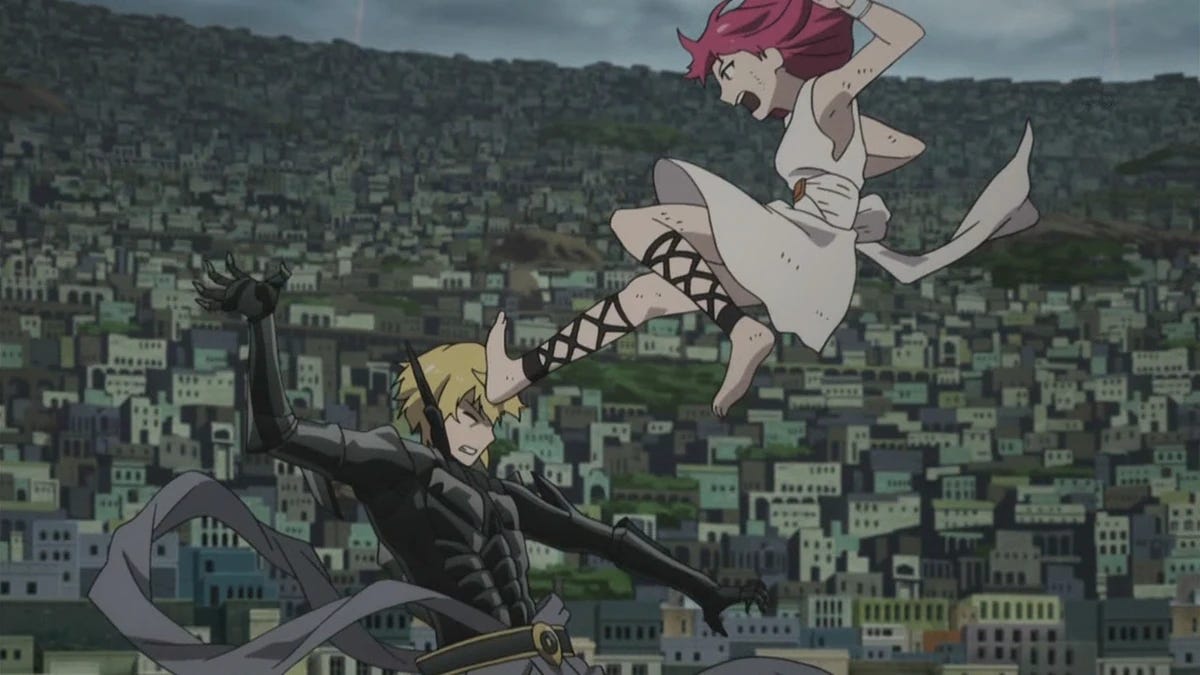
All of this came together in my new character for the Dark Tower game I mentioned last week. Because I had been watching soft-spoken little Morgiana kick the living hell out of people for about 30 episodes of Magi, I was hoping to roll up a Barbarian, which seem really overpowered in 1e and which in 30+ years I have never played. I’ve done the dual-class monk thing before, with Callista, and we had 8 levels to play with, so one of several possibilities I had in my head was a 4/4 Barbarian/Monk.
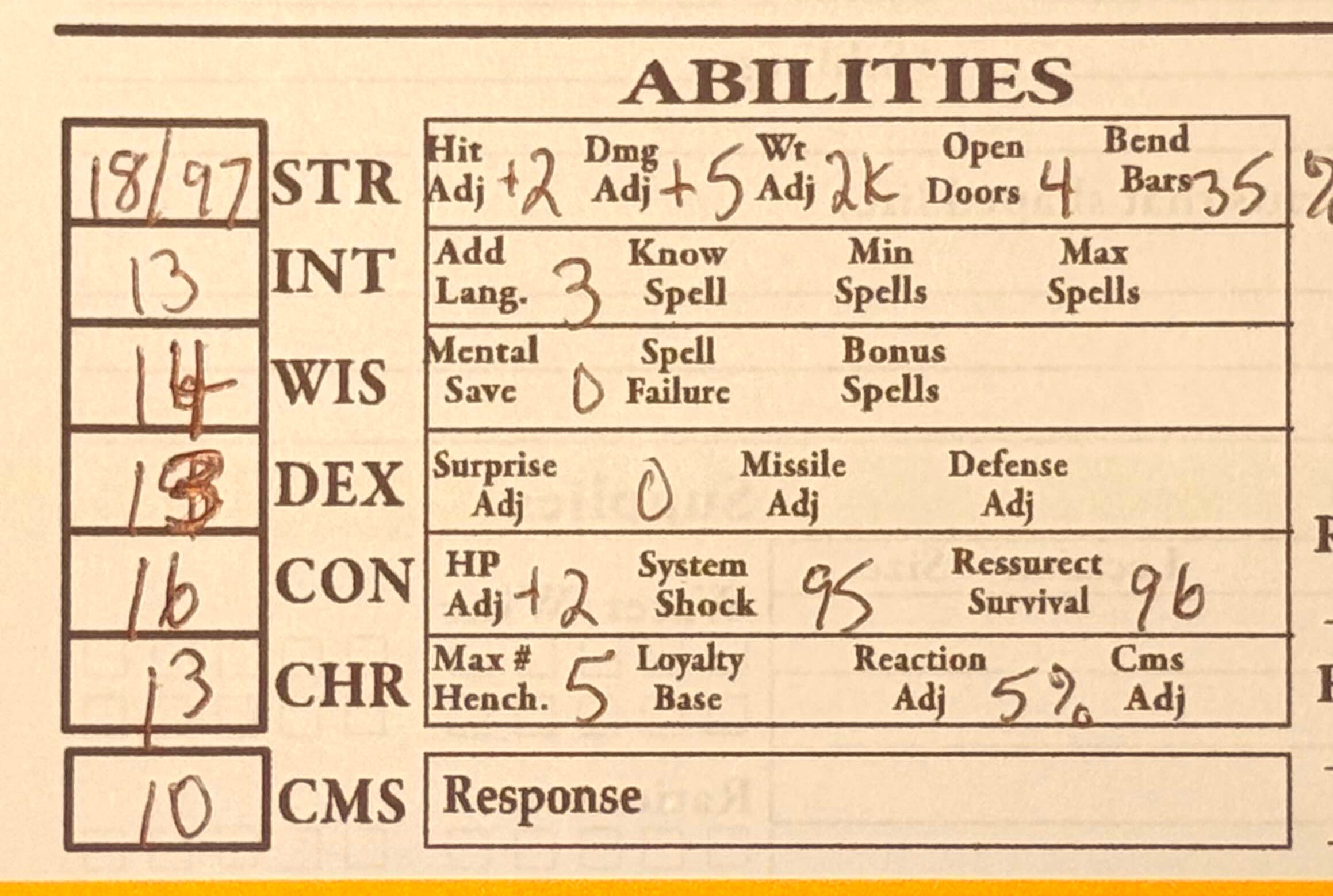
However, after four tries, even with 4d6-drop-the-lowest and put-’em-where-you-want-’em, I could not make the minimal stats for a Barbarian. With the addition of a seventh roll for Comeliness (which I had forgotten about, because later editions merged it with Charisma), my first set was eligible to be a Ranger. I was especially happy to have rolled an 18/97 Strength score. Not as strong as a Fanalis, but pretty impressive for a human, stronger even than half-ogre Nachtigall, who is like seven feet tall (and beefy, but not trained as a warrior).
I mentally merged a young Roald Dahl from this podcast and an even younger Alfred Tennyson from the book above into 24-year-old Grimsley Grue, the whimsical yet blood-drenched traveling name for a somewhat Witcher-ish professional monster hunter of whatever passes for the Druidic faith in this Dark Tower world. In that tradition (I say, not having read the background materials), “natural” animals are sacred, while artificially engineered monsters and cursed lycanthropes are considered profane. Lycan outcast unclean.4
That last part came from the fact that as 8th level characters, we were allowed to roll 5 magic items, and one of mine was a +1 sword, +3 vs lycanthropes and shape-changers.5 Also at 8th level, 1e Rangers can cast Druid spells, which meant Grimsley could easily have a pet owl (like Tennyson) and a donkey rather than a horse, and he could talk to them via spell. At 9th level (if he makes it that far) he’ll be able to cast the magic-user spell find familiar.6 Way cooler than that white-haired hoser Geralt of Rivia, who names every horse he has Roach.
On the down side, GG also personally has some odd, possibly heretical Agassiz-like ideas about moral degeneration leading to physical and mental degeneration, which are scientifically wrong and thankfully out of fashion in our culture now but not at all unusual in 20th century fantasy and science fiction worlds. For example, 1e has this rule where Rangers automatically get bonus damage against the entire Giant-kin genus, including:
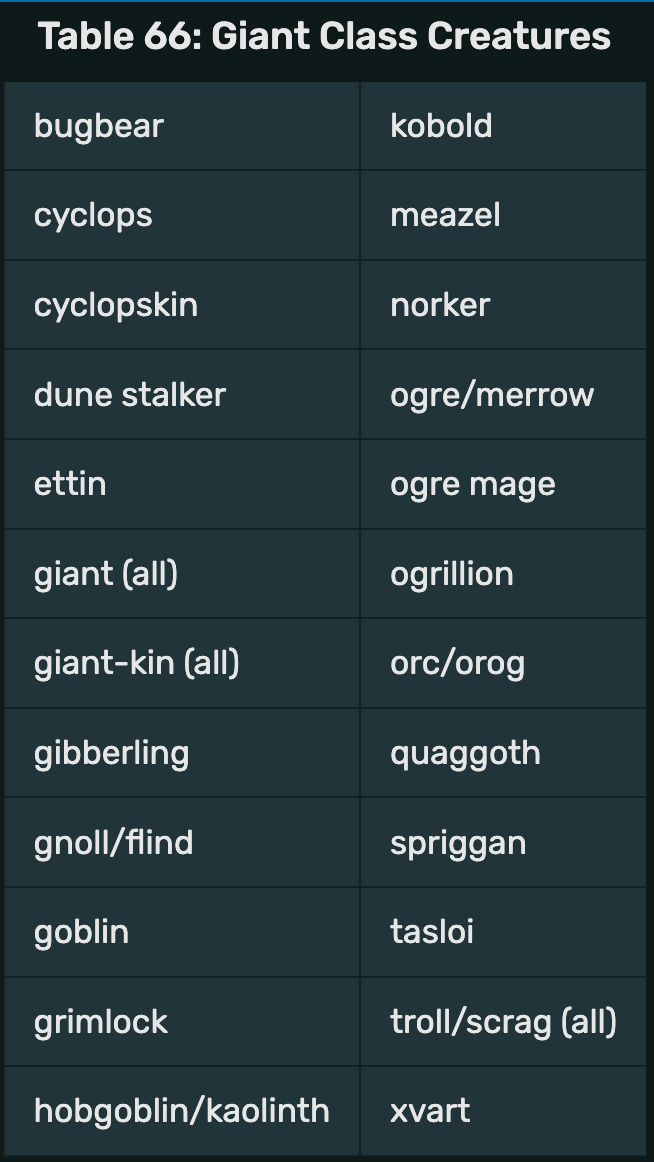
and that’s just genocidally racist. Justifying something so ridiculous (at least in my mind) requires another, more psychological backstory retcon. In the introductory you are unwelcome in our creepy village session of The Dark Tower, the Paladin-led party has already adopted a mentally slow hunchback named Rufo and an alcoholic former magic user named Beldar, as guides to the tunnels under the town. Why? Well, the GM said, “Alignment is important in this adventure,” and the Paladin is leaning in. If alcoholism is a disease, and Paladins can cure disease, that means Beldar’s all better now, right?7
Grimsley Grue is already thinking monster chow for both of them. As per the rules, Rangers are required to be aligned with Good. As per reality, though, what gets defined as Good depends on your personal values.
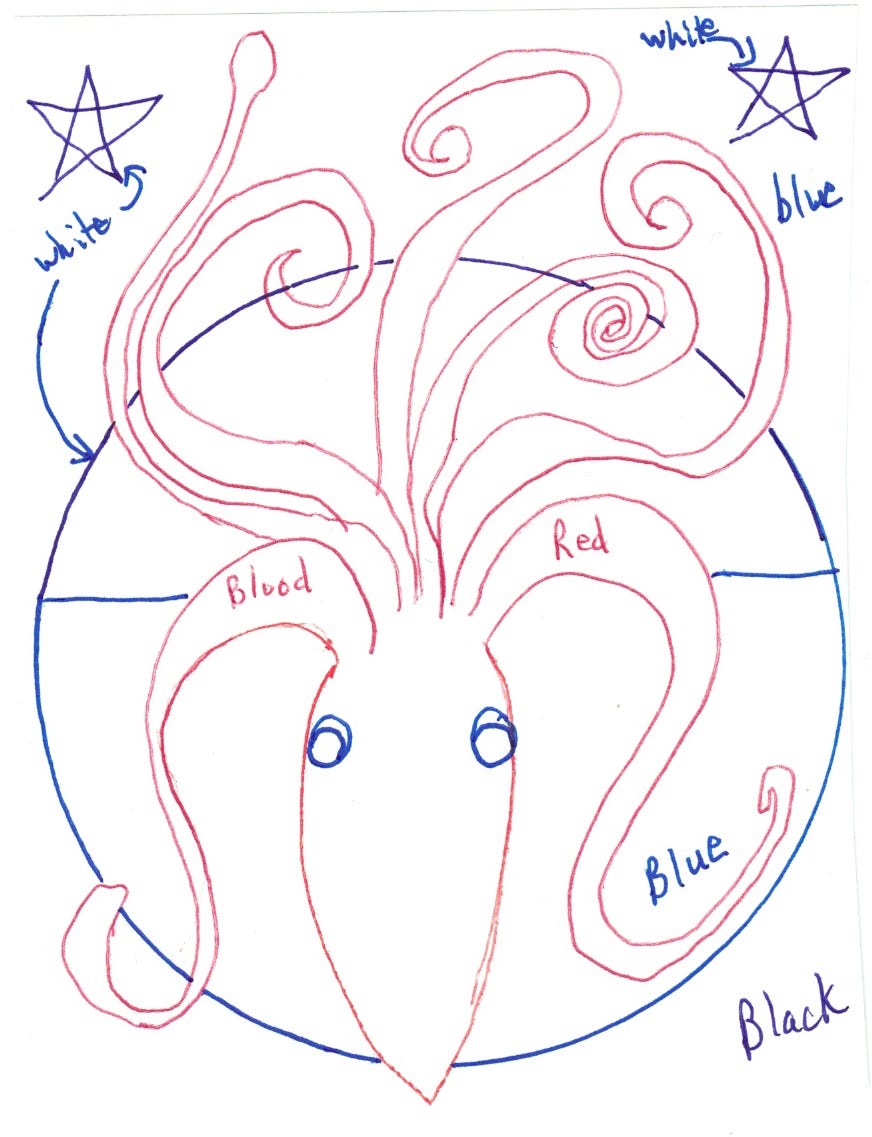
And when you’ve got a kraken on your shield . . .
REFERENCES
https://www.wired.com/2014/09/fantastically-wrong-legend-of-the-kraken/
https://blog.biodiversitylibrary.org/2014/10/release-kraken
Although a good death is cool. See Spango Garnetkiller the Seventeenth in the indie movie Of Dice and Men, linked below. I do not recall any of my characters having good deaths.

"We just gotta keep her from talking about her backstory.” Of Dice and Men is my favorite little indie gaming play-turned-movie. Especially the lack of self-loathing, and even more the lack of self-pity, which was such a feature of the otherwise excellent Slash.
Not meant in a date-rape rohypnol kind of way but just in the mysteriously effective alchemy kind of way.
Those Thomas Covenant scars just never go away.
It just occurred to me that the Bloodguard are a lot like the Fanalis. Huh.
I’m definitely not afraid of a good ret-con, especially early in a character’s career, if it improves the overall story.
D&D has always made this hard separation between worldly magic, which is more science-y, and divine magic that requires gods. The history of magic on Earth makes a mockery of this convenient separation.
I will admit to using a similarly convenient plot logic with Laudanum in my solo reboot of that character.

As I think about it more, purify food and water would probably just remove the drug from the blood, making cravings worse, though I still like the idea that cure disease would offer temporary relief, while it might require something higher level like a remove curse to prevent those inconvenient relapses.
"People have strong opinions on the ideal method for generating stats."
"I hope no one expects scientific rigor from tweets reported on an RPG blog, but if you do, have a salt shaker handy as I report my scientific findings and then muse on why I use 3d6-in-order (with some baroque tweaks)."
https://prismaticweekly.substack.com/p/in-defense-of-3d6
Nice discussion of our human insistence that evil be ugly, dirty, and often contagious.
https://modernmythologiesnewsletter.substack.com/p/miyazaki-and-the-face-of-evil